
Plumber in Adelaide: General Plumbing and Maintenance
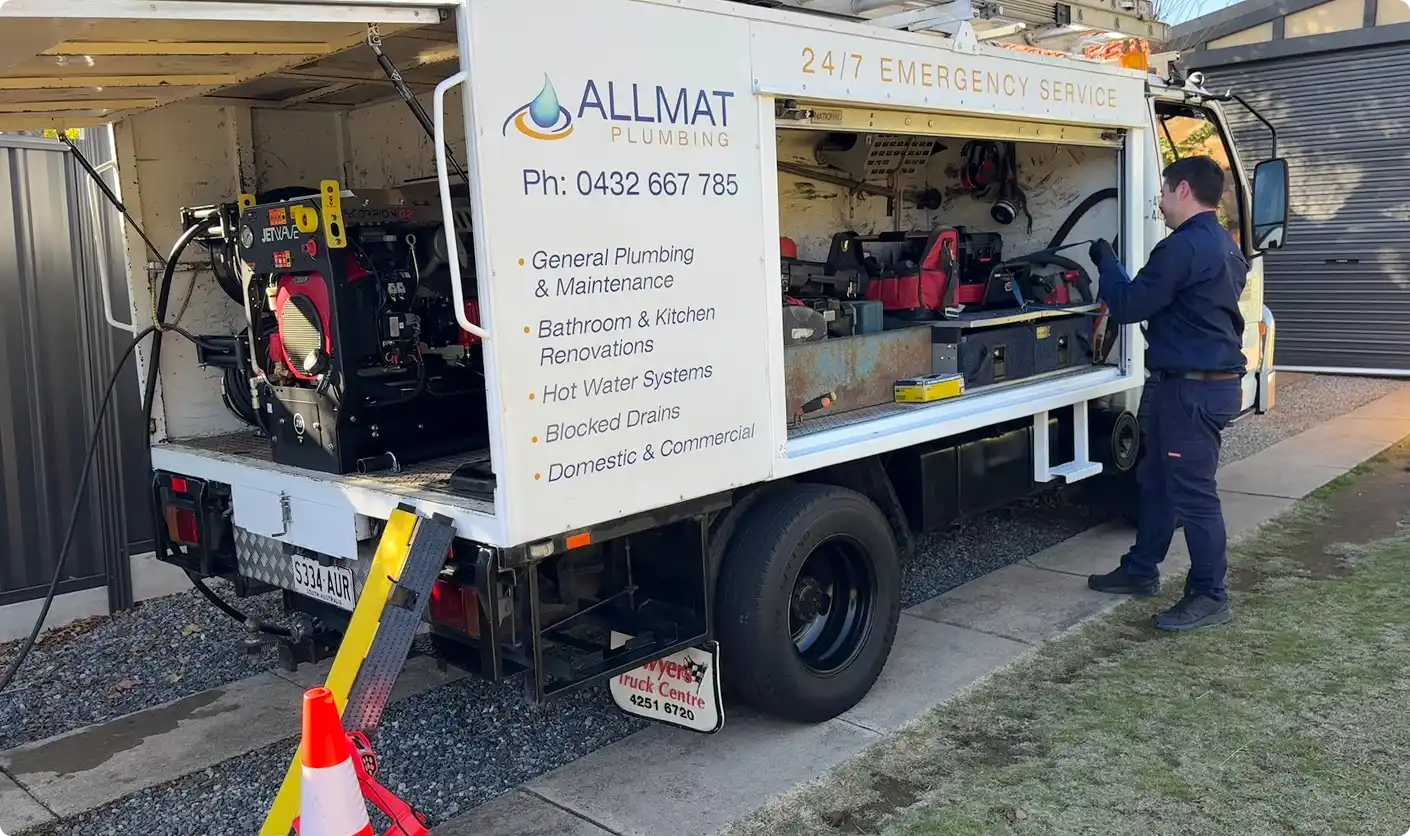
Allmat Plumbing is a licensed plumber and gas fitter covering Adelaide from Westbourne Park. Marc does the work himself, has 20 years on the tools, texts an arrival time before setting off, and discusses the price before starting. General plumbing covers the everyday work: taps, toilets, hot water, blocked drains, burst pipes, leak detection, gas appliances and the rough-in for a renovation. The 2 things worth knowing before you call anyone in South Australia are how to check a licence on the Consumer and Business Services register, and where SA Water's responsibility ends and yours begins.
Related: Emergency Plumbing · Blocked Drains · Hot Water
What general plumbing actually covers
General plumbing is the maintenance and repair work that keeps a house running, as opposed to the specialist jobs that need a machine on a truck. In practice it is the same handful of calls repeating across every Adelaide suburb.
- Tap and mixer repairs, washer and ceramic disc cartridge replacement, and outdoor tap renewal.
- Toilet repairs: running cisterns, failed inlet and outlet valves, leaking pan collars, and full suite replacement.
- Hot water repairs and replacement across electric, gas, solar and heat pump systems.
- Leaking and burst pipes, including galvanised supply pipe replacement in older homes.
- Blocked drains, sinks, basins and floor wastes, and the camera work when a blockage keeps returning.
- Leak detection on a high water bill, including the meter test that establishes whether there is a leak at all.
- Gas appliance installation, gas leak work and heater servicing, which needs a gas fitting licence as well as a plumbing one.
- Renovation rough-in and fit-off for kitchens, bathrooms and laundries, and relocating waste and supply points.
- Stormwater work: downpipe connections, silted or collapsed stormwater lines, and correcting a downpipe that has been run into the overflow relief gully, which belongs to the sanitary drain rather than the stormwater system.
- Water filters, pressure limiting valves, tempering valves and isolation valves fitted where they should have been in the first place.
What we will not do is quote a specialist job we have not looked at. A recurring blockage cannot be judged honestly without a camera down the drain, and a hot water replacement cannot be judged honestly without seeing the space, the fuel type and the clearances. We would rather look first and then discuss a number we can stand behind.
Where SA Water stops and you start
This is the single most useful thing an Adelaide homeowner can know, because it decides who pays, and the boundary is not where most people assume.
| Asset | Whose problem it is |
|---|---|
| The water main in the street | SA Water |
| The service pipe from the main to the meter | SA Water |
| The water meter itself | SA Water |
| Every pipe from the meter outlet into and around the property | The property owner |
| The sewer main in the street | SA Water |
| The connection from the main to your property boundary | SA Water |
| The private sanitary drain from that connection to the house | The property owner |
| The overflow relief gully in the yard | The property owner |
| Stormwater drainage on the property | The property owner |
| Every tap, cistern, hot water unit and fixture | The property owner |
The practical consequence: a wet patch on the footpath side of the meter is a free phone call to SA Water, and a wet patch on the house side is a plumbing bill. The same logic applies to sewage, and a surcharging inspection point at the boundary can point either way. That is exactly why locating a fault matters before anyone starts charging to fix it.
If you do find a hidden leak, do not repair it and throw the paperwork away. SA Water will consider an adjustment on a bill inflated by a concealed leak, and what they ask for is evidence: a dated invoice or report from a licensed plumber describing the leak and the repair. Get it in writing at the time, because reconstructing it 3 months later is a different conversation.
What breaks, by the era your house was built
Adelaide plumbing faults are strikingly predictable by build era, because each era used the materials of its day and those materials fail on their own timetable. Knowing the era tells you what to expect and what to plan for, which beats a generic maintenance checklist.
| Era | Supply pipe | Drainage | What fails first |
|---|---|---|---|
| Pre-1930 villas and cottages | Galvanised steel | Vitrified clay sewer, cast iron stacks | Galvanised corroding from the inside, and roots entering the open clay joints |
| 1920s to 1940s garden suburbs | Galvanised, early copper | Vitrified clay, shared easement drains | The same faults repeating street by street, because the housing is uniform |
| 1950s to 1960s brick and tile | First-generation copper | Clay sewer, terracotta stormwater | Pinhole leaks at copper fittings, and relief gullies buried by later landscaping |
| 1970s to 1980s | Copper, some polybutylene | PVC starting to appear | Polybutylene fittings turning brittle and splitting, usually without warning |
| 1990s to 2000s | Copper and early PEX | PVC sewer and stormwater | Braided flexible hoses under vanities and sinks, and failed shower waterproofing |
| 2010s onward | PEX from a manifold | PVC | Flexible hoses again, tempering valves at about 5 years, and slab movement on reactive sites |
The braided flexible hose deserves a special mention, because insurers consistently name it among the leading causes of household water damage claims in Australia. It costs almost nothing, it lives under your kitchen sink and behind your vanity, and it has a service life of roughly 5 to 10 years. Next time that cupboard is open, look at the braid. Rust spots, fraying strands or a bulge anywhere along it means replace the hose now.
Adelaide reactive clay, and the plumbing it breaks
The Adelaide plains sit largely on the Keswick and Hindmarsh clays, and those soils are highly reactive: they swell as they take up water and shrink hard as they dry. Under AS 2870, the residential slabs and footings standard, a site is classified by how far its surface moves through that cycle. Class M sites move up to 40mm, Class H1 up to 60mm, Class H2 up to 75mm, and Class E sites more than 75mm. Large parts of metropolitan Adelaide sit in the H and E bands, which is a great deal of movement for a rigid clay pipe with mortared joints to absorb.
That single fact explains most of the drainage work in this city. Sewers laid in short lengths of vitrified clay are worked open a fraction at a time, season after season. Once a joint is open, the tree roots that thrive in a dry Adelaide February have a reliable water source, and a blockage becomes an annual event rather than an isolated incident.
- Keep stormwater away from the footings. A downpipe discharging beside the house creates a permanently wet zone against soil that is dry everywhere else, and differential movement is what cracks things.
- Fix leaks under slabs promptly. A slow leak under a slab on reactive clay causes localised heave, which is a structural problem long before it is a plumbing one.
- Water established gardens evenly rather than in bursts. Wetting and drying cycles do more damage than either state alone.
- Plant with the drain line in mind. The species that cope best with Adelaide summers are the ones that hunt hardest for water.
- A drain that blocks on a seasonal rhythm and clears easily is not a usage problem. Book the camera, not another machine clean.
How we work, and what you get in writing
Plumbing is a licensed trade in South Australia and the licence is public information. Consumer and Business Services licenses plumbing, gas fitting and electrical work, and the register is searchable online at no cost. Marc holds both a plumbing and a gas fitting licence, which is why a job with gas in it does not need a second trade attending, and you are welcome to look him up on the register.
- The price is discussed with you before work starts, and it goes in writing on anything larger than a service call.
- We tell you whether that number is a fixed price or an estimate, and exactly what would change it.
- A Certificate of Compliance is issued where the work is notifiable plumbing or any gas work.
- You get shown the evidence: camera footage of a drain, a photo of the failed part, a meter reading before and after.
- Allmat works from a real address in Westbourne Park with a phone number that reaches Marc, not only a lead form.
For what it is worth, the thing customers mention most often about Marc in his published reviews is not the work and not the price. It is the text with an arrival time before he sets off, and then arriving when he said he would.
When you do not need a plumber
Some of what gets called in is not a job at all, and saying so on the phone is a better use of the call than sending a van.
- Replacing a tap washer, a shower rose, a toilet seat or a flexible shower hose is not licensed work. If the isolation valve turns and you are comfortable, do it yourself.
- A relief valve on a hot water unit that dribbles while the tank heats is doing exactly what it was designed to do. A constant stream, or discharge when the unit is cold, is the fault worth calling about.
- A basin draining slowly while the rest of the house is fine is a pop-up waste or a trap full of hair, not a sewer blockage. Take the plug assembly out and clean it.
- Water beading on the cold pipe under the kitchen sink during a humid week is condensation. Dry it, wrap a paper towel around the pipe, and check it a day later.
- A gurgle during a very heavy load that clears on its own is air displacement, not a blockage forming.
- A sulphur smell near a floor waste that has not been used for weeks is a dry trap. A bucket of water costs nothing and usually ends it.
The reverse is worth stating just as plainly. Turn the water off at the meter and call immediately for water running that you cannot stop, sewage coming back up inside the house, no water at all to the property, a hot water unit leaking from the cylinder, or any smell of gas. Those 5 do not improve overnight, and most of them get materially more expensive if they wait.
Questions we get asked
How do I check a plumber is licensed in South Australia?
Consumer and Business Services licenses plumbing, gas fitting and electrical work in South Australia, and the register is searchable online for free. Search the licence and confirm the class covers the work being done, because water plumbing and gas fitting are separate authorisations. Marc holds both, so a job with gas in it does not need a second trade attending, and you are welcome to look him up before we start.
Who is responsible for the water pipe between the meter and the house?
You are. SA Water owns and maintains the main in the street, the service pipe from the main to the meter, and the meter itself. Everything from the meter outlet onward is the property owner's responsibility, including the pipe running under your front lawn. That is why a wet patch on the street side of the meter is a free call to SA Water and a wet patch on the house side is a plumbing job.
Do I need a licensed plumber to change a tap washer?
No. Replacing a tap washer, a shower rose, a toilet seat or a flexible shower hose is maintenance rather than licensed plumbing work, and you can do it yourself. The line is drawn where the work alters the water service, the drainage system or a gas installation: new pipework, moving a fixture, replacing a hot water unit, connecting an appliance to gas. All of that requires a licensed person and, in most cases, a compliance certificate.
What is a Certificate of Compliance and when should I get one?
It is the document a licensed plumber or gas fitter issues certifying that notifiable work complies with the relevant standard. You should receive one for gas installation work and for notifiable sanitary plumbing and drainage. Keep it: it is what an insurer wants after an incident, what a conveyancer wants at sale, and what a manufacturer wants on a warranty claim. We issue yours as part of the job.
My water bill has jumped. How do I find out if I have a leak?
Run the meter test. Turn off every tap and water-using appliance, including the irrigation controller and the ice maker, then read the meter and note every digit including the small dials. Wait 30 minutes without using water and read it again. Movement means a leak on your side of the meter. No movement means the bill has another cause: a seasonal irrigation change, a cistern that was running and has since stopped, or an estimated reading. Keep the plumber's report either way, because SA Water will consider an adjustment where a concealed leak is documented.
My mains pressure seems very high. Does that matter?
Yes. High static pressure shortens the life of every flexible hose, tap, cistern valve and appliance solenoid in the house, and it is a common cause of both water hammer and unexplained hose failures. The plumbing standard limits pressure at a fixture outlet to 500 kPa on new work, achieved with a pressure limiting valve at the meter. Fitting or replacing one is a small job, and on a high-pressure Adelaide street it pays for itself the first time it prevents a burst hose.
When do I find out what the job involves?
Before any work starts. Marc looks at the job, tells you what it needs and why, and the price is discussed with you at that point. You will not get a number on an invoice that you have not already heard and accepted. He also texts an arrival time before setting off, so you are not holding an entire morning open.
Suburbs we cover for general plumbing & maintenance
You might also find this useful
- What Is Water Hammer, and Why Are Your Adelaide Pipes Banging?A bang after the washing machine stops is a pressure wave arriving, not a fitting coming loose. Here is what causes it in Adelaide homes, how to work out which cause is yours, and the fixes in order of how involved they are.
- Galvanised vs Copper Pipes: When Replacement Is Actually DueMost pre-1960s Adelaide homes were plumbed in galvanised steel, and it corrodes shut from the inside. Here is how to identify what you have, which symptoms genuinely mean the pipe, and how to stage the replacement without wrecking the plaster.
- Shocked by Your SA Water Bill? The 15 Minute Test That Finds the LeakA quarterly bill that doubles is either a leak or it is not, and there is a free 15 minute test that settles the question before anyone is paid to look. Here is the test, the arithmetic behind it, where Adelaide leaks actually hide, and how to tell when there is no leak at all.
- The Plumbing Rough-In: What to Lock In Before the Walls CloseRough-in is the stage that decides whether a bathroom renovation runs smoothly or ends with tiles coming off. Here are the Australian set-out numbers, the finished floor level trap, what a concrete slab changes, and when the whole stage can be skipped.
- Emergency PlumbingEmergency plumbing across Adelaide, 24/7. Burst pipes, sewage backing up, gas leaks and failed hot water, attended by a licensed plumber and gas fitter with the price discussed before work starts.
- Blocked DrainsBlocked sewer, toilet, sink and stormwater drains cleared across Adelaide with a jetter and an electric machine, then filmed with a CCTV camera so you find out what caused it.