
Patch Pipe Relining Adelaide: Fix a Cracked Drain Without Digging Up the Yard
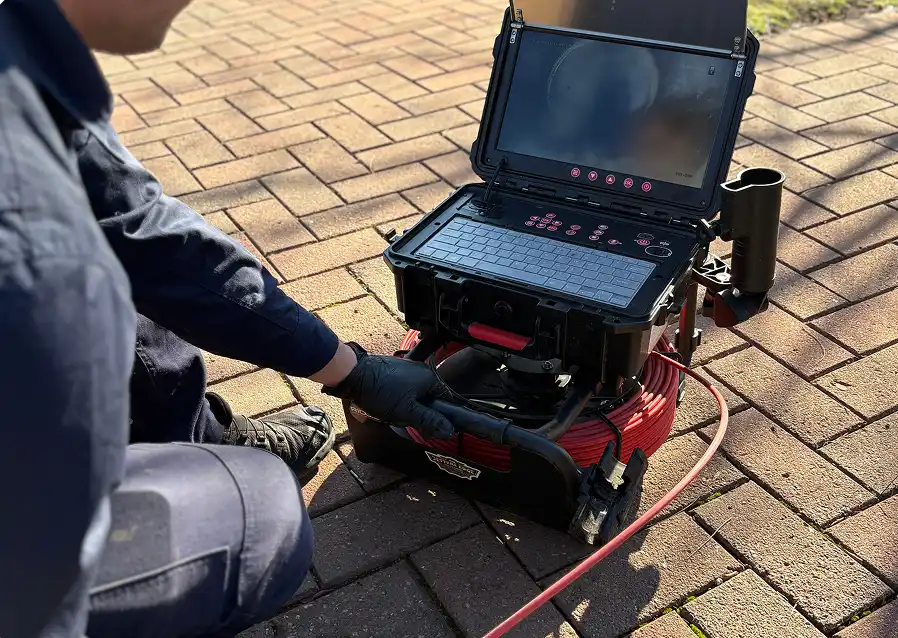
Patch relining repairs a cracked or root-invaded section of drain from the inside, without excavating. A resin-saturated liner is drawn to the damaged spot, inflated against the pipe wall and cured hard, forming a new jointless section inside the old pipe. We do patch and sectional relining, which is the right fix for a single cracked joint or a short damaged run. It is the wrong fix for a pipe that has already collapsed, and we will tell you when that is what the camera shows.
Related: Blocked Drains · CCTV Drain Inspection · Hydrojet Drain Cleaning
What patch relining actually is
Patch relining is a structural repair carried out through an existing opening, with no trench. A short flexible liner, saturated in a 2-part epoxy resin, is drawn along the drain to the damaged section and inflated against the pipe wall. Once the resin cures, that liner is a rigid pipe in its own right: jointless, smooth-bored and bonded to the original pipe. The old pipe becomes a mould rather than a component.
The point that gets lost in most explanations is that a patch is not a bandage over a hole. Across its length it replaces the structural function of the pipe. That is why it holds against root pressure and ground movement, and why it stops root intrusion permanently rather than for a season.
- A patch typically covers a single defect, usually a cracked joint or a short damaged length.
- Several patches can be installed along the same drain where the camera shows more than one distinct fault.
- The repair is done through an existing inspection opening, so nothing is dug up and nothing needs reinstating afterwards.
Why Adelaide drains crack in the first place
Adelaide has a specific problem, and it is the reason relining is worth understanding here rather than reading a generic guide. Large parts of the inner suburbs were sewered with vitrified clay pipe laid in short lengths with mortar or rubber-ring joints. Unley, Goodwood, Hyde Park, Malvern, Norwood, Prospect and Colonel Light Gardens are full of it. Clay does not rot and it does not rust, so the pipe barrel often survives a century in good order. The joints do not.
Add the reactive clay soils under most of Adelaide, which swell through winter and shrink hard through a dry summer, and those joints get worked open a millimetre at a time. Then add the street trees that make those suburbs desirable in the first place. A jacaranda, a plane tree or an ornamental pear will send roots toward the one reliable source of water and nutrient in a dry February, and a 1mm gap in a sewer joint is all the invitation required.
The trap is that clearing roots is quick and relining is not, so it is genuinely tempting to keep clearing. That works fine for a while. It stops working when the root mass has been cut back enough times that the joint has opened further, the pipe starts taking soil as well as roots, and a section drops out of alignment. At that point the simple option is gone and the repair is a bigger one.
When a patch is the right fix, and when it is not
Choosing the right method matters more than the method itself, because the wrong one costs more than either done properly. Here is how we decide.
A patch is the right call when:
- The camera shows one cracked joint or one short damaged length, with sound pipe either side of it.
- The pipe still holds a roughly round cross-section, so there is something for the liner to form against.
- The fault sits under a driveway, a slab, paving, a retaining wall, or a tree worth keeping.
- The property is in a heritage area, where excavating the frontage means a council conversation nobody wants.
- Reaching the fault by digging would mean trenching through a neighbouring property or a shared easement.
A patch is the wrong call when:
- The pipe has already collapsed. There is nothing left to line against.
- There is a severe misalignment or a dropped joint with a significant step. A liner follows the fault rather than correcting it.
- The whole run is failing rather than one section. Needing a patch in 6 places is a sign the line wants replacing, not patching.
- The pipe is badly undersized for its load. A liner slightly reduces internal diameter, so it makes an undersized pipe marginally worse.
- The defect is shallow, in open lawn, and reachable in a couple of hours. Digging is quicker and less disruptive there.
The process, start to finish
- Clear the line. Nothing can be inspected or lined through a blocked pipe, so it is jetted first, usually with a root-cutting head.
- CCTV inspection. The camera runs the length of the drain and each defect is located and measured from the surface with a sonde locator. You see the footage.
- Report and recommendation. Defect positions, depths, pipe diameter and material, and a straight answer on whether a patch will hold or whether the line needs something else.
- Preparation. The pipe is cleaned back to bare wall so the resin bonds properly, which usually means a second jetting pass with a cutting or descaling head.
- Patch installation. The resin-saturated liner is positioned at the defect and inflated against the pipe wall.
- Curing. The resin hardens in place, typically over a few hours depending on the system and the conditions.
- Final CCTV. The finished patch is filmed so you can see the repair, and you keep that footage.
Most patch repairs are a single-day job and the water stays on. The drain cannot be used while the resin cures, so plan for a few hours without the toilet or the laundry.
What you should be given at the end
- The pre-repair camera footage, so you can see the defect that justified the work.
- The post-repair camera footage, so you can see the finished patch.
- A written report with defect locations measured from a fixed reference point.
- The manufacturer warranty on the liner, and the workmanship warranty in writing.
- A Certificate of Compliance where the work is notifiable sanitary plumbing.
Keep all of it. If the property sells, a documented drain repair with before and after footage answers a building inspector question immediately, and a drain with a known history is worth more than one with an unknown one.
Questions we get asked
Do you do full pipe relining or just patches?
Patch and sectional relining. That covers a single cracked joint or a short damaged length, and several patches can go into the same drain where the camera shows separate faults. We do not do full-length end-to-end relines of an entire house drain. If that is genuinely what your line needs, we will tell you after the inspection rather than sell you a patch that will not solve it.
Is pipe relining worth it?
It is worth it when the pipe still holds its shape and excavating would be disruptive or damaging: under driveways, paving, slabs, established trees or heritage frontages. It is not worth it on a collapsed pipe, on a badly misaligned run, or on a shallow defect in open lawn that can be dug and replaced quickly. Relining is a method, not an upgrade, and the right answer depends entirely on what the camera shows.
How long does a relined section last?
Liner manufacturers rate cured-in-place liners at 50 years, and the relined section is jointless, so the root intrusion route that caused the original failure is closed permanently. The practical limit is usually the un-relined pipe either side of the patch, which is the same age and the same material as the section that just failed.
Can tree roots grow back through a patch?
Not through the liner itself. Roots enter through joints and cracks, and a cured liner has neither along its length. Roots can still enter through a separate defect further along the drain, which is exactly why the whole line is filmed rather than just the section being repaired.
Do I need a camera inspection first?
Always, without exception. A patch is only the right repair for specific, visible defects, and nobody can tell you whether yours qualifies without looking. The inspection also establishes whether the fault sits on your private drain or on the SA Water side of the boundary, which decides who is responsible for fixing it.
Do I need council or SA Water approval to reline a drain?
Work on the private sanitary drain within your property boundary is notifiable plumbing work in South Australia and must be carried out by a licensed plumber, who issues a Certificate of Compliance. Work on the SA Water main or the connection point is SA Water responsibility, not yours. Part of a proper inspection is establishing which side of that boundary the defect sits on.
Does insurance cover pipe relining?
Sometimes, and it turns on the wording. Many home policies exclude gradual deterioration and root damage, which covers most of the reasons a drain cracks, but some cover the resulting damage even where they exclude the pipe itself. Dated camera footage and a written report from a licensed plumber are what an insurer will ask for, so get both before starting any repair.
How disruptive is it compared with digging?
Considerably less, which is the entire point. There is no trench, so the driveway, paving, lawn and any established trees over the drain are untouched, and there is nothing to reinstate afterwards. Access is through an existing inspection opening, and most patch repairs are done in a day with the water still on.
Suburbs we cover for pipe relining
You might also find this useful
- Pipe Relining vs Pipe Replacement: How to Choose the Right RepairPatch relining and excavation are 2 tools for 2 different faults. The pipe conditions that decide it, what the camera has to show before a liner is an option, and when digging is genuinely the better repair.
- Tree Roots in Pipes: The Adelaide Guide to Stopping the DamageA drain that blocks every year around the same time is not being overused. It is taking tree roots through an open joint. Here is how roots actually get in, which Adelaide trees do it, what each fix genuinely buys you, and the treatments that waste money.
- The Overflow Relief Gully: What It Is, and Why Yours Is BlockedAn overflowing ORG is not a fault, it is the safety valve doing its job. What to do in the first 5 minutes, how to check yours is installed legally, and who pays for the blockage.
- Blocked DrainsBlocked sewer, toilet, sink and stormwater drains cleared across Adelaide with a jetter and an electric machine, then filmed with a CCTV camera so you find out what caused it.
- CCTV Drain InspectionA RIDGID SeeSnake camera and locator find the exact fault in a drain, how far it sits from the house and how deep it is, so the repair is priced on evidence instead of guesswork.
- Hydrojet Drain CleaningHigh-pressure water jetting that removes roots, fat, scale and silt from sewer and stormwater lines, followed by a camera run so you know what condition the pipe was actually in.