
Blocked Drains Adelaide: Clear It, Then Find Out Why It Blocked
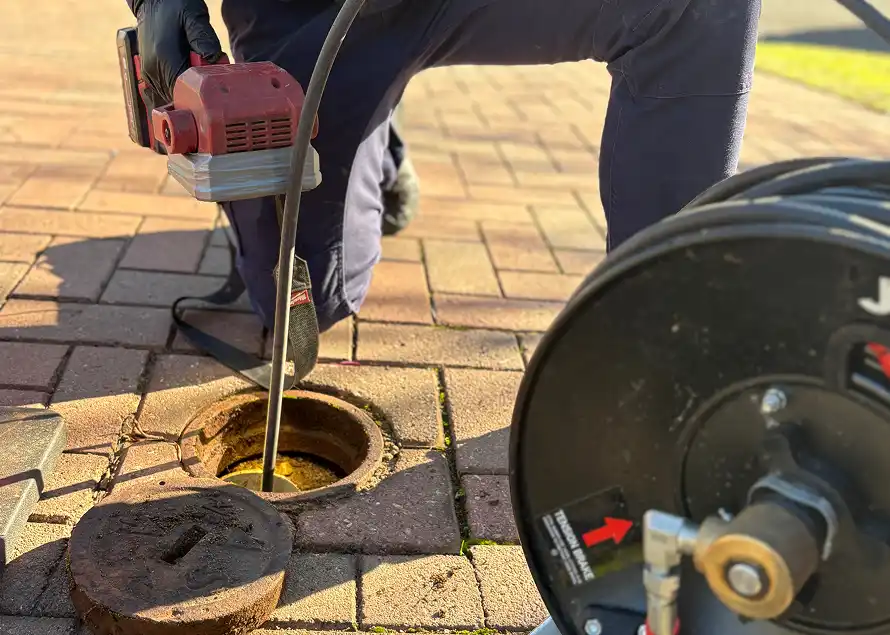
Most Adelaide blockages are 1 of 3 things: tree roots through the open joints of a clay sewer, wipes and fat compacted at a bend, or a broken section of pipe collecting everything that passes it. A machine or a jetter clears all 3 in an hour. Only a camera tells you which one it was, and that is what decides whether you are done or whether it comes back next season. Allmat Plumbing clears blocked drains across the inner south, the western suburbs and the Adelaide Hills, with a jetter and a CCTV camera on the truck.
Related: Pipe Relining · CCTV Drain Inspection · Hydrojet Drain Cleaning
What the symptoms tell you before anyone arrives
A blocked drain is not one problem, it is 4 or 5 different problems that look alike from the kitchen. You can narrow it down yourself in a minute, and it changes what the job is and what it costs.
| What you are seeing | Where the blockage is | How urgent |
|---|---|---|
| A single basin, sink or shower drains slowly, everything else is normal | In that fixture's own branch or trap, within a few metres | Not urgent. Book it in normal hours |
| Toilet rises then drains slowly, and the shower gurgles when you flush | Past the point where those 2 fixtures join | Soon. It is progressing toward a full block |
| Every fixture is slow, and the lowest one backs up first | The main sanitary drain, between house and boundary | Urgent. Stop using all fixtures |
| Sewage surging out of the grated gully in the yard | Downstream of the gully, in the main drain or at the connection | Urgent, but the house is being protected. Stop all fixtures |
| Neighbours have the same problem at the same time | Very likely SA Water's main, not your drain | Ring SA Water first on 1300 729 283 |
| Overflow only in heavy rain, no sewage smell | Stormwater, a separate system entirely | Not urgent once the rain stops, unless water enters the building |
Gurgling is the most useful sound in plumbing and almost nobody listens to it. A partial blockage forces waste water to drag air back through a trap seal instead of venting properly. Gurgling from a shower when the toilet flushes puts the restriction past the junction of those 2 fixtures, and it is warning you about a blockage that has not fully formed yet. That is the easiest and least disruptive moment to deal with it.
Why Adelaide drains block, specifically
Ask that in Brisbane and the answer is different. Adelaide has its own combination: the age of the housing, the pipe that went into the ground with it, and a soil that never sits still.
The inner suburbs were sewered with vitrified clay, laid in short lengths and joined with mortar. Goodwood, Unley, Malvern, Hyde Park, Norwood, Kensington, Colonel Light Gardens and Black Forest are full of it. Clay is chemically inert, so the pipe barrel routinely survives a century. The joints were never designed to move, and Adelaide's reactive soil moves them: it swells through a wet winter and shrinks hard through a dry summer, flexing everything buried in it a fraction of a millimetre at a time. What you are left with is a sound pipe with a gap every 600mm or so.
Now add what makes those suburbs worth living in: mature street trees, jacarandas, plane trees and ornamental pears. In a dry February the most reliable water available to a root system is a sewer, and roots find a 1mm gap the way water finds a crack. They do not break into the pipe. They walk in through a door the soil opened, then thicken into a mat that catches everything the household flushes.
Roots are the headline, not the whole list. This is the rest of what comes out of Adelaide drains.
- Wipes, including every product marked flushable. They do not break down like paper, and they knit together around anything already in the pipe.
- Cooking fat, which leaves the sink as a liquid and sets solid on the first cold length of pipe it reaches.
- Hair and soap matting in shower branches, the most common cause of a slow shower and nothing to do with your sewer.
- Sand and silt, particularly in coastal and western suburbs, settling in the flat sections of stormwater lines.
- Bathroom renovations tied into original drainage never graded for a second wet area, so the new branch runs flat and holds waste.
- A collapsed or dropped section of pipe, which is no longer a blockage problem but a repair problem.
The overflow relief gully, and why it just saved your carpet
That grated riser near your bathroom wall is an overflow relief gully, the most important fitting on the property that nobody can name. It is deliberately the weakest point in the system: when the main drain blocks and pressure builds, the grate lifts and the sewage discharges into the garden. That is not a fault. It is the fitting making the overflow happen outside rather than through the shower floor.
For that to work, 2 conditions have to hold. The gully must sit lower than the lowest fixture inside the house, and it must sit above the surrounding ground so garden runoff cannot pour into the sewer during a downpour. Decades of Adelaide landscaping have quietly broken both: paving over the top, a raised garden bed, a new deck, extra topsoil, or a path poured level with the grate.
If your gully is overflowing right now, the useful thing you can do is stop adding to it. A dishwasher or washing machine cycle will pump another 40 litres into a pipe with nowhere to send it. Turn them off, keep everyone out of the shower, and keep children and pets away from the discharge until it has been cleared and hosed down.
Your drain or SA Water's: where the boundary sits
This decides who pays, and most people find out the hard way. SA Water owns the sewer main and the connection point where your property drain joins it. Everything between that point and your fixtures is private drainage and belongs to the owner. Water supply works the same way: SA Water owns the main and the meter, you own the pipe from the outlet side of the meter onward.
- Blockage in the street main or on SA Water's side of the connection: theirs to clear, at no cost to you.
- Blockage in the private drain between your house and that connection: yours, and a job for a licensed plumber.
- Broken or root-invaded pipe inside your boundary: yours, including the repair, reline or excavation.
- Overflow hitting several properties in the street at once: almost always the main, so ring SA Water first.
- Leaking or faulty water meter: SA Water. The pipe from the meter into your house: yours.
If you genuinely cannot tell which side the fault sits on, ring SA Water first on 1300 729 283. If the problem is theirs they clear it and it costs you nothing. If it turns out to be on your side of the connection, it becomes a private plumbing job and you may be charged for the visit. The tell is usually whether anyone else in the street has the same problem at the same time.
Part of a proper camera inspection is establishing exactly where a defect sits relative to that boundary, measured from a fixed surface point with a sonde locator. That measurement turns an argument into a fact, and it is worth having in writing either way.
How a blocked drain actually gets cleared
There are 4 tools for the job, and choosing the wrong one is how a simple clear turns into a repair.
- Plunger and hand auger. Fine for a toilet, a basin or a shower trap, and worth trying yourself before calling anyone. Useless on a main drain.
- Electric drain machine, the eel. A rotating cable with a cutting head, fed in from an inspection opening. It punches through roots, wipes and compacted waste, and it is the economical answer for most main-drain blockages.
- High-pressure water jetter. Where the eel cuts a hole through the blockage, a jetter scours the pipe wall back to bare surface and flushes the debris away. It is what fat, silt and heavy root mats need, and the only method that leaves a pipe fit to be relined.
- CCTV camera with a locator. Not a clearing tool, a diagnosis tool. It runs the cleared line, shows the defect, and marks its position and depth on the surface so nobody digs a hole guessing.
On a straightforward blockage the machine goes in, the water runs, and that is the visit. Where the extra money earns its keep is a camera run on any drain that has blocked more than once. Clearing without looking is how a household pays for the same blockage 4 times in 3 years, and 4 clearing visits cost more than 1 inspection and a targeted repair.
What not to do, and what does not work
- Caustic drain cleaner. It generates heat in a pipe already full of standing water, it rarely reaches a blockage more than a metre down, and it distorts PVC waste pipe and destroys rubber seals. It also makes the drain genuinely dangerous for whoever opens it next, which will be a plumber with their face over the opening.
- Boiling water down a PVC waste. Water at 100 degrees softens PVC and can deform a trap or a joint. Hot tap water on a soap and grease film in a kitchen sink is fine. Boiling water on a root blockage does nothing at all.
- Salt down the drain every night. This one circulates endlessly online with no mechanism behind it. Salt does not dissolve roots, fat or wipes, and rock salt sold for root killing is ineffective at the concentration that survives dilution.
- Flushing anything marked flushable. Wipes, cotton buds, dental floss, cat litter and paper towel all pass the toilet and stop at the first bend that matters.
- Hiring a heavy machine and running it yourself. A cable that catches in a clay joint can pull the pipe apart, and that repair costs far more than the clearing job would have.
The 2 things genuinely worth doing yourself: plunge a single blocked fixture properly before calling anyone, and run a kettle of hot tap water down the kitchen sink weekly if the household cooks with a lot of fat. Everything beyond that does nothing, or does damage.
Related services
- Blocked Toilet: Blocked toilets cleared properly, from a plunger-and-auger job at the pan through to jetting a root-blocked sewer drain. We tell you plainly when it is a job you can finish yourself.
- Stormwater Drain Cleaning: High pressure jetting, pit clearing and CCTV inspection for blocked and broken stormwater drains. Roof water moved away from the house properly, which on Adelaide clay matters more than most people are told.
- Tree Root Removal: Root cutting, high pressure jetting and CCTV diagnosis for root-invaded sewer and stormwater drains, with a straight answer on whether a clearing cycle or a permanent repair is the better spend.
Questions we get asked
Why pour salt down the drain every night?
There is no reason to, and the advice keeps circulating because it sounds like a household remedy should. Salt does not dissolve fat, it does not break down wipes or paper, and it does not kill tree roots at any concentration that survives being diluted by the water already in the pipe. Rock salt sold as a root treatment has the same problem and is unkind to metal fittings on the way past. Nothing you pour down a drain fixes a mechanical blockage, because the blockage is a physical object sitting in a pipe.
How to unblock a severely blocked drain?
A severe blockage, meaning every fixture in the house is affected or sewage is surfacing, is not a plunger job and no product poured down a fixture will touch it. Stop using every fixture including the washing machine and the dishwasher, keep people away from any overflow, and get the drain opened at an inspection point. From there it is an electric machine to punch through and restore flow, then a jetter to scour the pipe wall clean, then a camera to find out what caused it. If the same drain has done this before, the camera is the part that actually ends the problem.
Does pouring boiling water down a drain help unclog it?
On a light soap and grease film in a kitchen sink, hot water helps. On anything else it does not, and boiling water is a genuine risk to modern plumbing. Water at 100 degrees softens PVC waste pipe and can deform a trap or a joint, and it will damage the seals in a chrome bottle trap under a basin. Use hot tap water rather than boiling, and understand that it has no effect at all on roots, wipes or a broken pipe.
Who is responsible for a blocked sewer, me or SA Water?
SA Water is responsible for the sewer main in the street and the connection point where your drain joins it. Everything between that point and your fixtures is private drainage and belongs to the property owner. The quickest test is whether anyone else in the street has the same problem at the same time, which points at the main. If you are unsure, ring SA Water on 1300 729 283 first. If the fault is theirs, they clear it at no cost to you. If it turns out to be on your side of the connection, it becomes a private plumbing job.
Why does my drain block at the same time every year?
That is tree roots in a clay sewer, and the timing tracks the dry months when root systems hunt hardest for water. Roots enter through joints that Adelaide's reactive soil has opened over decades, then grow into a mat that catches paper and fat. Clearing works and buys you roughly a season. A camera inspection is what tells you whether the joints have opened far enough that a patch reline over the defect works out cheaper across 5 years than clearing it every spring does.
Can I clear a blocked drain myself?
A single blocked fixture, yes, and it is worth trying. Plunge it properly with the overflow covered, or clean out the trap under a basin, which is where hair and soap collect. What is not worth doing yourself is hiring a drain machine for a main sewer blockage. A cable that catches in an open clay joint can pull the pipe apart, and the excavation that follows costs several times what the clearing job would have. If every fixture is affected, stop and make the call.
Will you have to dig up my yard?
Usually not. Clearing is done through an existing inspection opening, and where a single length of pipe is damaged, a patch reline repairs that section from the inside without excavation. Digging becomes the right answer when a section has fully collapsed, when a run has dropped badly out of alignment, or when the defect is shallow and sits under open lawn where a short dig is quicker than a patch. Whichever it is, you should be shown the camera footage that justifies it before anyone starts.
Suburbs we cover for blocked drains
You might also find this useful
- The Overflow Relief Gully: What It Is, and Why Yours Is BlockedAn overflowing ORG is not a fault, it is the safety valve doing its job. What to do in the first 5 minutes, how to check yours is installed legally, and who pays for the blockage.
- Why Is My Kitchen Sink Gurgling When I Flush the Toilet?The gurgle is air being pulled through a trap seal. Which fixture makes the noise, and which fixture triggers it, tells you whether you are dealing with a free fix under the sink or a root-blocked sewer near the boundary.
- Are Flushable Wipes Really Flushable? What Adelaide Drains ShowToilet paper falls apart in minutes. Wipes labelled flushable do not. Here is what the testing found, why Adelaide clay sewers catch them so reliably, and how to tell a wipe blockage from a root blockage.
- Do Supermarket Drain Cleaners Damage Your Pipes?Most pages on this subject say never use them, which readers do not believe because the bottle sometimes works. Here is the accurate version: what is in it, what it damages, the narrow case where it is a fair choice, and the symptoms that mean it will never help.
- Tree Roots in Pipes: The Adelaide Guide to Stopping the DamageA drain that blocks every year around the same time is not being overused. It is taking tree roots through an open joint. Here is how roots actually get in, which Adelaide trees do it, what each fix genuinely buys you, and the treatments that waste money.
- Pipe ReliningTrenchless patch repair for a cracked or root-invaded drain. A resin liner is cured inside the damaged section, so the fault is fixed permanently without digging up the yard.