
Why Is My Kitchen Sink Gurgling When I Flush the Toilet?
A sink that gurgles when you flush the toilet is air being dragged through the water seal in the trap, because the drain cannot get air from where it is supposed to. When only 1 fixture reacts, the cause is almost always a partial blockage in that branch or a trap problem within a metre or 2 of the outlet. When several fixtures gurgle together, the shared drain or the vent is restricted, and in Adelaide that is most often tree roots in a clay sewer. The noise itself is harmless. What it signals is not.
Need this sorted rather than explained? Blocked Drains in Adelaide. Also worth reading: The Overflow Relief Gully: What It Is, and Why Yours Is Blocked · Pipe Relining vs Pipe Replacement: How to Choose the Right Repair
What the gurgle actually is
Every fixture in the house sits above a trap: the U-bend under the kitchen sink, the S-bend cast into the toilet pan, the bell trap in a laundry floor waste. The trap holds a small plug of water, and that plug has exactly 1 job. It stops sewer gas travelling back up the pipe and into the room.
A toilet flush sends roughly 4.5 litres down the drain in a couple of seconds. That slug of water behaves like a piston. It pushes air ahead of it and pulls a partial vacuum along behind it. A drainage system in good order feeds air into that vacuum through the vent, which is the pipe running up through the roof and finishing in a cowl. If the vent cannot supply air fast enough, the system takes it from the next easiest source available, and that source is the water sitting in a nearby trap. The air is dragged through the water as bubbles, and the bubbles are the gurgle you can hear.
There is a second consequence that matters more than the noise. Every time a trap gets siphoned, some of that water seal leaves with the air. Siphon it often enough and the seal drops below the weir of the trap, at which point the barrier between your kitchen and the sewer is gone. That is why a persistent gurgle and a sewer smell so often turn up together.
Which fixture gurgles tells you where the fault is
Before touching a plunger, spend 5 minutes mapping the behaviour: which fixture makes the noise, which fixture triggers it, and whether anything drains slowly. That map is the same one a plumber builds on arrival.
| What you observe | Most likely fault | Where it sits |
|---|---|---|
| A single sink gurgles, only when that sink drains | Partial blockage in that fixture branch | Within a metre or 2 of the trap |
| Kitchen sink gurgles when the toilet flushes | Restriction downstream of where those 2 lines meet | The shared branch or the run toward the boundary |
| Several fixtures gurgle and the lowest one drains slowly | Main sanitary drain is partly blocked | Between the house and the boundary, often at a junction or under a tree |
| Gurgling plus a sewer smell indoors | Trap seals being pulled and not refilling, or a vent fault | The vent stack, the roof cowl, or a dry trap |
| Toilet water level rises and falls on its own | Air moving through a restricted main line | Downstream of the toilet. Treat this one as urgent |
| Gurgling only during or straight after heavy rain | Stormwater finding its way into the sanitary drain | A cross-connection, a surcharged main, or a downpipe wrongly connected |
The rule underneath the table is simple enough to use without any tools. The fault sits downstream of every fixture that reacts, and upstream of every fixture that does not. On a typical single-storey Adelaide house that logic is usually enough to tell you whether you are looking at a free fix under the sink or an excavation near the front fence.
The 4 causes, ranked by how often they turn out to be the answer
- Partial blockage in the branch. Congealed fat, coffee grounds, rice, hair and soap build a collar inside the pipe. Water still passes, so nothing looks blocked, but the reduced bore starves the line of air and the nearest trap pays for it.
- Tree roots in the main sanitary drain. The signature Adelaide cause in any suburb sewered with vitrified clay. The pipe barrel survives a century, the mortared joints do not, and a root mass in the run restricts both water and air.
- A blocked or restricted vent. Gum leaves, a bird nest, a wasp nest, a rusted-flat cowl, or a vent that was capped off during a re-roof and never reinstated. The drain is clear, the air supply is not.
- A trap or vent arrangement that was never right. Island bench sinks with long unvented waste runs, a bathroom relocated to the far side of the house, or a new fixture teed into a line with no vent within the distance AS/NZS 3500.2 allows. This one gurgles from the day the renovation finished.
The ranking shifts with the age of the house, and knowing which era yours belongs to narrows the list before anyone opens a drain. On an inner-southern home built before 1960, roots are the most probable of the 4, because the drain is clay with open joints and the street trees of Goodwood, Unley, Hyde Park, Malvern and Norwood are extremely good at finding them. On a house built or fully re-plumbed in the last 20 years, roots drop a long way down the list, because the drain is PVC with rubber-ring joints. There, a vent problem or a renovation design fault is far more likely, and the fix is a much smaller job.
What to check yourself in 10 minutes
- Run each fixture on its own, in turn, and listen at the others. Isolating them is what separates a branch fault from a shared one.
- Fill the kitchen sink completely, then pull the plug. A full sink puts a real load down the branch. A collar of fat that lets a trickle past will gurgle loudly under that volume.
- Go outside and find the overflow relief gully. It is the grated riser near the bathroom or laundry wall, and its grate should sit clear of the surrounding ground. If it is holding water or smells, the main drain is involved.
- Look up at the roof from the ground and find the vent pipe. A cowl that has collapsed, a nest, or a plumbing vent that no longer projects above the roof line are all visible without a ladder.
- Check any fixture used rarely. A spare shower, a guest basin or a laundry floor waste can lose its seal to evaporation in a fortnight of Adelaide summer. Run the tap for 30 seconds and see whether the noise and the smell both go.
Why this happens so often in Adelaide
Adelaide gives this fault more opportunities than most cities. The inner south and inner east were sewered with vitrified clay laid in short lengths and jointed with mortar. Clay does not rust and does not rot, so the pipe itself is often fine after 100 years. The joints are the weak point, and our reactive clay soils work them open a fraction at a time as the ground swells through a wet winter and shrinks hard through a dry summer. A gap of 1mm is all a root needs.
That produces a very recognisable pattern: a drain that gurgles and slows on a seasonal rhythm, clears easily when a machine goes through it, and comes back on roughly the same schedule the following year. Clearing it treats the symptom. A camera inspection is what establishes whether the joints have opened far enough that a patch reline over the affected section has become the better answer measured over 5 years.
Post-war brick and tile suburbs such as Panorama, Pasadena, Mitcham and Ascot Park present it differently. The more common trigger there is ground movement pulling a joint apart, plus overflow relief gullies that decades of paving and raised garden beds have left buried. In the Adelaide Hills, a gurgle on a septic or community wastewater system can mean a saturated trench or a full tank rather than a blocked pipe at all.
When to act today, and when it can honestly wait
Not every gurgle needs a plumber. A fair share are free to fix yourself in 10 minutes, and a fair share of the rest can wait a week without any consequence.
- Get it looked at today: sewage appearing at the overflow relief gully or in a shower base, a toilet whose water level rises after a flush, more than 1 fixture backing up, or a sewer smell that returns within hours of running water.
- Book it in this week: a single fixture that gurgles and drains slowly, a gurgle that has been getting steadily louder over a few months, or a drain with a known history of root blockages that has started talking again.
- It can genuinely wait: an occasional gurgle in a fixture that drains normally, with no smell and no slow flow anywhere else in the house.
- You probably need nobody at all: gurgling and a faint smell in a bathroom used once a month. That is evaporation, and running the tap for 30 seconds refills the trap.
A gurgle that started the week a renovation finished belongs in its own category. It is a venting or grading fault built into the work, not a blockage, and no amount of clearing will touch it. That needs the drainage layout examined against what was actually installed, which is a very different visit from a drain clean.
What a proper diagnosis looks like
- The line is cleared first, usually by jetting, because nothing can be inspected through a partly blocked pipe.
- A CCTV camera runs the length of the drain and the defects are located from the surface with a sonde locator, so their position and depth are known rather than guessed.
- You are shown the footage on site and given a copy to keep.
- A written report follows with defect positions measured from a fixed reference point, the pipe material and diameter, and a recommendation with the reasoning attached.
- If the camera finds a clean, sound pipe, the answer is the vent, and the report should say so plainly.
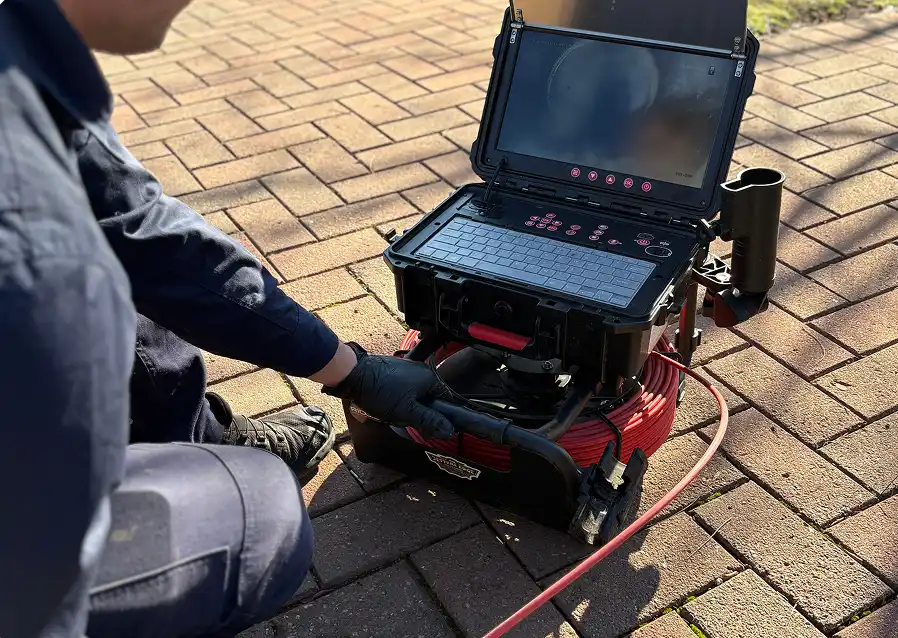
Marc runs a Jetwave jetter and a RIDGID SeeSnake camera with a locator, which is what makes it possible to answer the question properly rather than by elimination. You get a text with an arrival time before he sets off, and the price is discussed before any work starts.
Questions we get asked
Why is my kitchen sink gurgling when I flush the toilet?
Because the toilet flush is pulling air out of a shared section of drain faster than the vent can replace it, so the system draws air through the water sitting in your kitchen trap instead. The restriction causing that is downstream of the point where the toilet branch and the kitchen branch meet. In an older Adelaide home with a clay sewer, roots in the main run are the usual reason. In a newer or recently renovated home, a blocked vent or an unvented waste run is more likely.
If the kitchen, toilet and shower all gurgle, does that mean they share a problem?
Yes. When fixtures on different branches all react to the same event, the fault has to be at or beyond the point where those branches join, which means the main sanitary drain or the vent serving it. That moves the job from a fixture repair to a drain investigation, and it is the point at which a camera inspection stops being optional. Multiple fixtures reacting together also means the margin before a full backup is small.
Is a gurgling drain dangerous?
The noise is not. The consequence can be. Each gurgle removes a little of the water seal in the trap, and a trap that loses its seal lets sewer gas into the room. Sewer gas is unpleasant at low concentrations and genuinely hazardous at high ones. If you can smell sewer inside the house, ventilate the room, refill the traps by running every tap for 30 seconds, and get the cause found rather than living with it.
Will a chemical drain cleaner stop the gurgling?
Almost never, and it frequently makes the visit that follows harder. Gurgling is caused by restricted air, restricted flow, or both. A caustic cleaner does nothing to a root mass, nothing to a blocked roof vent, and nothing to an unvented waste run. Where the cause is a fat collar in a kitchen branch it may buy a few weeks. It also leaves a pipe full of corrosive liquid that has to be dealt with safely before anyone can work on it.
Why does my toilet gurgle when it rains?
That points to stormwater entering the sanitary drain, which it is not meant to do. The usual causes are a downpipe or an area drain wrongly connected into the sewer, an overflow relief gully sitting below the surrounding ground so runoff pours straight into it, or a surcharged main during heavy rainfall. The first 2 are on your side of the boundary and fixable. Establishing which applies needs the drain traced, not guessed.
References
You might also find this useful
- Blocked DrainsBlocked sewer, toilet, sink and stormwater drains cleared across Adelaide with a jetter and an electric machine, then filmed with a CCTV camera so you find out what caused it.
- The Overflow Relief Gully: What It Is, and Why Yours Is BlockedAn overflowing ORG is not a fault, it is the safety valve doing its job. What to do in the first 5 minutes, how to check yours is installed legally, and who pays for the blockage.
- Pipe Relining vs Pipe Replacement: How to Choose the Right RepairPatch relining and excavation are 2 tools for 2 different faults. The pipe conditions that decide it, what the camera has to show before a liner is an option, and when digging is genuinely the better repair.
- Why Do My Drains Smell Like Rotten Eggs, and How Do You Fix It?Rotten egg means hydrogen sulphide, and there are only 3 realistic sources in a house. Work out which one you have first, because the fix for a dry trap, a biofilm build-up and a hot water anode have nothing in common.