
Pipe Relining vs Pipe Replacement: How to Choose the Right Repair
Patch reline when the pipe is cracked, root-invaded or has open joints but still holds a roughly round cross-section, especially where it runs under a driveway, paving or a slab. Replace when the pipe has collapsed, dropped badly out of alignment, is undersized for its load, or sits at shallow depth in open lawn where a dig takes a couple of hours. Relining is a method, not an upgrade, and we do patch or sectional liners rather than full-length end-to-end relines. The camera footage decides which repair your drain needs.
Need this sorted rather than explained? Pipe Relining in Adelaide. Also worth reading: Why Is My Kitchen Sink Gurgling When I Flush the Toilet? · The Overflow Relief Gully: What It Is, and Why Yours Is Blocked
The 2 methods, in plain terms
Relining rebuilds a pipe from the inside. A flexible liner saturated in a 2-part epoxy is drawn into the damaged length through an existing opening and inflated hard against the pipe wall. When the resin cures, that liner is a rigid, jointless, smooth-bored pipe in its own right, and the original pipe has been demoted from a component to a mould. No trench, no reinstatement, and the surface above it never knows the job happened.
We do patch relining, also called sectional relining. The liner covers the defective length and a margin either side of it, rather than running end to end through an entire house drain. That suits the way Adelaide drains actually fail, because the damage is usually concentrated at a handful of joints rather than spread evenly along every metre.
Replacement removes the old pipe and lays a new one. On a domestic Adelaide sewer that almost always means an open trench, because the runs are short, the depth is moderate, and the ground between the house and the boundary is usually crowded with water, gas and stormwater services that make trenchless boring more trouble than it saves. The trench is the easy part. Putting back whatever was above it is usually the bigger half of the job.
The 6 pipe conditions that decide it
The method is chosen by what the camera finds, and by nothing else. Everything in the table below is visible on the footage, which means you can watch it being decided on screen.
| Condition of the pipe | Correct method | Why |
|---|---|---|
| Open or displaced joints with root intrusion, barrel round and in line | Patch reline | The pipe wall is sound. A jointless liner over that section closes the entry route permanently rather than for a season |
| Cracks along or around the pipe, no deformation | Patch reline | The liner takes over the structural job across the patched length, so cracks within that length are 1 repair |
| A section fully collapsed or crushed flat | Replace | There is no host pipe left to line against, so a liner has nothing to hold its shape |
| Dropped joint with a step, or a length of back-fall holding water | Replace | A liner follows the existing shape. It preserves a fall fault instead of correcting it |
| Pipe already undersized or at capacity for the household | Replace | A cured liner takes a few millimetres of bore. On a marginal line that is the wrong direction |
| 1 crushed section at shallow depth under open lawn | Replace | A short dig and a new length of pipe is faster and less disruptive than mobilising a relining rig |
Notice what is absent from that list. The age of the pipe does not decide it, the material does not decide it, and how much the owner would like to avoid a dig does not decide it. A 110-year-old vitrified clay sewer under a Malvern villa, barrel intact and joints open, is close to an ideal patch reline. A 30-year-old PVC line crushed under a vehicle crossover is not a candidate at all, despite being 80 years younger.
Where patch relining wins
Relining earns its place when excavation would have to destroy and rebuild something on the way to the pipe. In those situations it is not the better option by a little, it is the better option by a multiple.
- The run passes under a concrete driveway, a paved courtyard, a crossover or a garage slab. Reinstatement of those surfaces routinely costs more than the pipework itself, and decorative concrete cannot be patched invisibly.
- The pipe is under or beside a footing, an extension slab or a retaining wall. Excavating there brings in engineering, possible underpinning, and a risk to the structure that relining simply does not create.
- A tree worth keeping sits over the line. Digging through a mature root plate can kill the tree years later, and on the tree-lined streets of the inner south the tree is often the reason the house is worth what it is.
- The property sits in a heritage overlay, or the defect is in the frontage. Excavating a heritage streetscape means a council conversation, a longer timeline and reinstatement to a standard nobody enjoys quoting.
- The drain runs through an easement or under a neighbouring property. Relining works from your own inspection point. Trenching means access agreements and a second party with an opinion.
- The blockage history is seasonal root intrusion through clay joints. A liner removes the joints along the patched length, so that entry route closes for good instead of reopening next February.
The Adelaide version of this is specific and repeatable. Large parts of Unley, Goodwood, Hyde Park, Malvern, Norwood and Colonel Light Gardens are sewered in vitrified clay laid in short lengths with mortared joints, on narrow allotments where the drain runs down a side passage under a paved path. Reactive clay soil works those joints open a fraction at a time across each wet winter and dry summer, and the street trees find the gap. That combination is exactly what patch relining exists for, which is why the method is so common here.
Where replacement wins
A liner is the wrong repair more often than the marketing around relining suggests. These are the conditions where digging leaves you with the better drain, and where we will say so on the day.
- The pipe has collapsed. A liner needs a host to inflate against, and rubble is not a host. Money spent lining a collapsed section buys a repair that fails.
- There is a fall problem. This is the fault worth understanding properly. A sanitary drain has to run continuously downhill toward the main, and a liner adopts whatever grade the old pipe has settled into. Relining a section that now holds water leaves you with a clean, warranted, jointless pipe that still holds water and still blocks.
- A joint has dropped with a visible step. The liner bridges the step rather than removing it, and the step keeps catching solids in exactly the way it did before.
- The drain is undersized for the house it now serves. A second bathroom, a granny flat or a subdivided allotment can put a load through a line that was sized for a 1930s household, and the answer there is a larger pipe, not a slightly smaller one.
- The defect is shallow, short and under grass. On a post-war Panorama, Pasadena, Ascot Park or Park Holme block with the sewer under open lawn, a 2 hour dig and a new length of PVC is quicker, cheaper and leaves a better pipe than any liner.
- The drain is about to be disturbed anyway. Relining a run that a planned extension, pool or driveway will cut through is money spent twice, and the second time will be worse.
Disruption, time and what you are left with
The 2 methods feel completely different to live through, and for a working household that matters as much as anything else in the decision.
| What you experience | Patch reline | Excavate and replace |
|---|---|---|
| Typical time on site | 1 day for a sectional repair in most cases | 1 to 3 days, longer if reinstatement is separate |
| Water supply | Stays on throughout | Stays on throughout |
| Use of the drain | Unavailable for a few hours while the resin cures | Unavailable while the line is open |
| Machinery in the yard | Truck at the kerb, hoses along the ground | Excavator or trencher, spoil heap, plate compactor |
| Surface afterwards | Untouched | Reinstated, and rarely an invisible match |
| Rated service life | Liner manufacturers rate cured liners at 50 years | New PVC drainage, laid to grade, comparable or better |
Both methods, done properly, outlive most of the people who commission them. The practical limit on a patch is not the liner, it is the un-relined pipe at either end, which is why the final camera run matters and why the report should say clearly what condition the rest of the drain is in. Ask for that in writing. It is the difference between knowing you have 1 more repair coming and finding out during a long weekend.
How the inspection decides it
The decision is only as good as the inspection underneath it, and a proper inspection follows the same sequence every time.
- The line is cleared first, usually by jetting, because a partly blocked pipe cannot be filmed or assessed.
- A CCTV camera runs the full length and every defect is located from the surface with a sonde locator, so position and depth are measured rather than estimated.
- You are shown the footage on site and given a copy to keep.
- A written report follows with defect positions measured from a fixed reference point, the pipe material and diameter, and the grade of the run.
- The recommendation names the method and the reasoning, including what was ruled out and why.
- If the camera shows a sound pipe, the report should say the drain does not need either method. That answer is available and it is sometimes the correct one.
Where a repair is required on the private drain inside your boundary, it is notifiable sanitary plumbing work in South Australia, carried out by a licensed plumber who issues a Certificate of Compliance. Defects beyond the connection point belong to SA Water rather than to you, and establishing which side of that line the fault sits on is part of the inspection, not an extra.
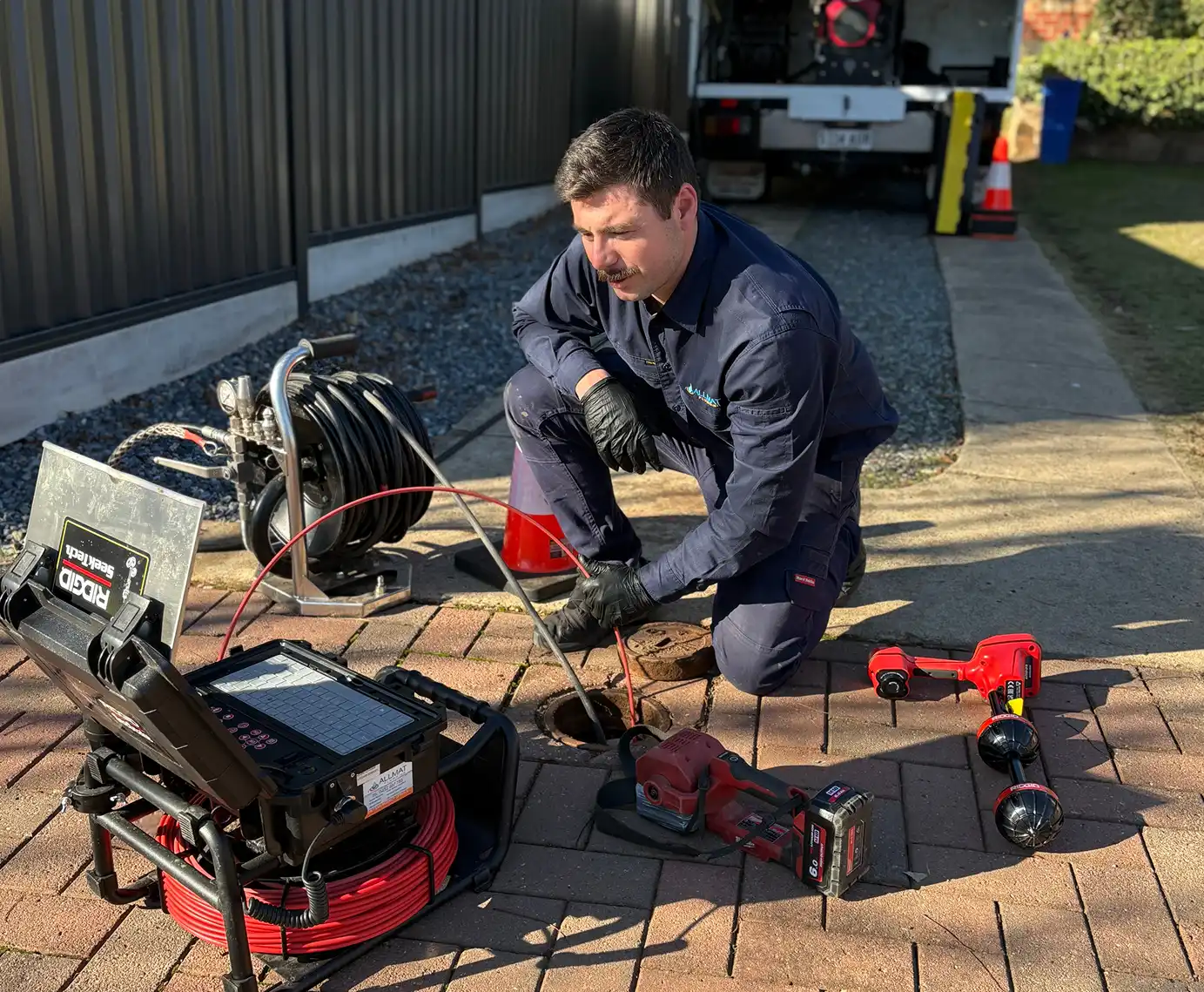
Marc runs a Jetwave jetter and a RIDGID SeeSnake CCTV camera with a locator, which is what makes it possible to answer this question from the footage. He is a licensed plumber and gas fitter with 20 years of hands-on experience, he texts an arrival time before he sets off, and the price is discussed before any work starts. If the camera says the drain does not need relining, that is what you will be told.
Questions we get asked
Is pipe relining worth it?
It is worth it when 2 things are both true: the pipe still holds its shape, and excavating to reach it would be disruptive or expensive. Under a driveway, a paved courtyard, a slab, a retaining wall, a mature tree or a heritage frontage, a patch liner is comfortably the better repair because it avoids reinstatement work that often outweighs the pipework. It is not worth it on a collapsed pipe, on a run with a fall problem, on a drain that needs to come up a size, or on a shallow defect under open lawn that can be dug and replaced in a couple of hours. Relining is a method suited to particular faults, not a general upgrade, and the camera footage is what tells you which situation you are in.
Is it better to reline or replace a sewer pipe?
Neither is better in general; they repair different faults. A patch liner is the correct repair for cracks, open joints and root intrusion in a pipe whose barrel is still round and still on grade. Replacement is the correct repair for collapse, a dropped joint with a step, back-fall, or an undersized line. The most common right answer on an older Adelaide property is actually a combination: dig out the metre that has failed, replace it in PVC, then patch the remaining defects through that opening. We go through the footage with you defect by defect, so the recommendation is tied to what the camera showed at each point rather than applied to the whole drain at once.
Can a collapsed pipe be relined?
No. A cured-in-place liner is inflated against the inside of the existing pipe and takes its shape from it, so it needs a continuous host to form against. Where a section has collapsed there is nothing to inflate against and often nothing continuous to pull a liner through. That section has to be excavated and replaced. The good news is that the collapse is usually short. Once the failed length is dug out and replaced, the new opening frequently becomes the access point for patching the remaining defects along the run, so a collapse does not rule out relining everywhere else.
Does relining make the pipe narrower?
Slightly, yes. The cured liner has a wall thickness, so the internal diameter of the patched section is a few millimetres smaller than the original. On a healthy DN100 house drain that loss is irrelevant, and it is more than offset by the finish: the liner is smooth-bored and jointless, so it carries flow better than a century-old clay pipe with mortared joints and root scarring. Where it does matter is on a drain that is already at capacity for the household it serves. On those lines the honest answer is a larger replacement pipe, because taking bore out of a marginal drain is the wrong direction.
How long does a relined pipe last compared to a new one?
Liner manufacturers rate cured-in-place liners at 50 years, and new PVC drainage laid to correct grade is comparable or better. The meaningful difference is not the material, it is the extent. Replacement renews the whole run, while a patch renews only the length that was lined and leaves the pipe either side at its original age, material and condition. That is why the post-repair camera footage and a written report on the rest of the drain are worth insisting on. Knowing that the next 6 metres are sound, or that they are not, is what turns a repair into a plan.
References
You might also find this useful
- Pipe ReliningTrenchless patch repair for a cracked or root-invaded drain. A resin liner is cured inside the damaged section, so the fault is fixed permanently without digging up the yard.
- Why Is My Kitchen Sink Gurgling When I Flush the Toilet?The gurgle is air being pulled through a trap seal. Which fixture makes the noise, and which fixture triggers it, tells you whether you are dealing with a free fix under the sink or a root-blocked sewer near the boundary.
- The Overflow Relief Gully: What It Is, and Why Yours Is BlockedAn overflowing ORG is not a fault, it is the safety valve doing its job. What to do in the first 5 minutes, how to check yours is installed legally, and who pays for the blockage.
- Why Do My Drains Smell Like Rotten Eggs, and How Do You Fix It?Rotten egg means hydrogen sulphide, and there are only 3 realistic sources in a house. Work out which one you have first, because the fix for a dry trap, a biofilm build-up and a hot water anode have nothing in common.