
Toilet Repairs Adelaide: Running Cisterns, Leaks and Weak Flushes
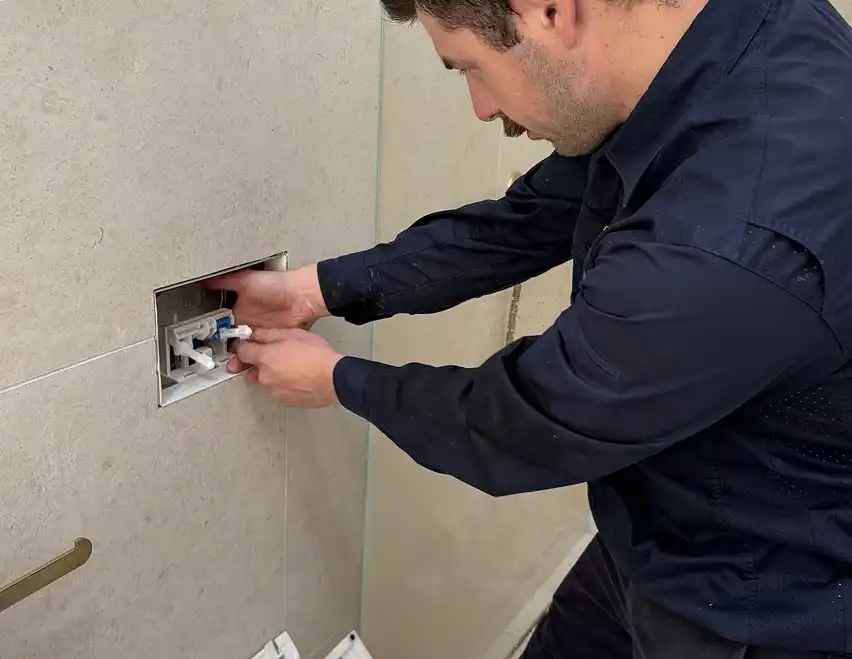
Most toilet faults are a worn part inside the cistern, not a reason to replace the suite. A toilet that runs constantly is almost always a failed outlet valve seal. A cistern that never stops filling, or whistles while it does, is the inlet valve. Water on the floor is the pan collar, the cistern-to-pan seal, or plain condensation. Parts for every common Australian cistern are on the shelf, and most of these repairs are a single visit. Replacement is genuinely warranted only when the pan or cistern is cracked, or when the suite is an orphan with no parts left.
Related: Blocked Toilet · Blocked Drains · Leaking Taps
Work out which fault you have before anyone opens the cistern
A toilet gives away its fault through the noise it makes and where the water sits. Working out which of the 4 common faults you have tells you whether the repair sits inside the cistern, at the pan, or further down the drain.
| What you notice | Most likely cause | What that means for the repair |
|---|---|---|
| Water trickling into the pan constantly, or the cistern refilling in bursts with nobody flushing | The outlet (flush) valve seal has perished or scaled up | Seal or complete outlet valve replaced. The cistern is drained, not removed. |
| Cistern never stops filling, water running to the overflow | The inlet (fill) valve is not shutting off, or the level is set too high | The water level gets adjusted first. The valve is replaced if the seal has gone. |
| Whistling or screaming while it fills | Worn inlet valve diaphragm, or the mini isolating tap is only part open | Usually a valve replacement. Sometimes just opening the isolating tap fully. |
| Weak or incomplete flush | Water level set low, a stretched flush linkage, or a partly scaled rim | Usually a simple adjustment. Almost never a reason to replace a suite. |
| Water pooling around the base | Pan collar, cistern-to-pan seal, or condensation | Told apart by which surfaces are wet and which stay dry. |
| Pan fills up then drains away slowly | A blockage in the pan trap or the branch drain | Not a cistern fault at all. This is a drain problem. |
What is actually inside an Australian cistern
Almost every domestic cistern in Adelaide, whatever the brand on the pan, contains the same 2 working parts. Understanding them turns a mystery noise into a named component you can point at.
- The inlet valve, or fill valve. It opens as the level drops, refills the cistern and shuts off at a set height. Bottom-inlet and side-inlet versions are both common here and they are not interchangeable.
- The outlet valve, or flush valve. It is the plug in the floor of the cistern, and its rubber seal sits on a moulded seat. When the seal or the seat degrades, the cistern leaks continuously into the pan.
- The button and linkage, which lifts the outlet valve. Dual flush suites use 2 lift heights, and that is the entire mechanism behind a half and a full flush.
- The overflow, usually built into the outlet valve body, which sends water to the pan rather than the floor when the inlet valve fails to shut.
Dual flush was an Australian invention and standard here since the 1980s, so Adelaide bathrooms hold 3 generations of it: the earliest at 11 and 5.5 litres, the 1990s generation at 6 and 3, and current suites at 4.5 and 3. The older the cistern, the more likely its button plate and outlet valve are a matched pair from a discontinued range, and the more likely a repair becomes a full mechanism replacement rather than a single seal.
Concealed cisterns behind a wall panel, common in bathrooms renovated in the last 15 years, are serviced through the flush plate. The plate lifts out and the valve assembly comes through the opening, so servicing one does not involve touching the tiling.
The running toilet, and the water it quietly wastes
A leaking outlet valve is the most expensive small fault in a house, because it runs continuously and makes almost no noise. A trickle you can only see by looking down the back of the pan is in the order of 100 to 200 litres a day, and SA Water bills quarterly, so it runs for most of a season before anything on paper mentions it.
What kills the seal is age plus water chemistry. Adelaide mains water carries meaningful hardness, and how hard depends on your supply zone and how much River Murray water is in the mix. Scale builds on the valve seat, the seal no longer sits flat, and a hairline path opens. Disinfectant blocks sitting in the cistern accelerate the same failure, because the chemistry that keeps the pan clean also degrades the rubber it is bathing. In-pan and rim-hung products do the same job without that side effect.
Water on the floor: 4 faults that look identical
A wet floor around a toilet always reads as urgent, and only some of the causes are. Where the water appears, and when, separates them.
- Condensation. Through an Adelaide summer, mains water sits well below the air temperature in a humid bathroom and the porcelain sweats. The whole cistern is evenly damp, it builds through the day rather than after a flush, and nothing needs repairing.
- The cistern-to-pan seal. Water appears immediately after a flush and the trail runs down from the back of the pan.
- The pan connection at the drain. Seepage at the base with a smell, usually caused by a pan that rocks. This is the one that matters, because waste water is going under the floor. In older Adelaide homes where the pan was bedded in cement, resetting it is the repair.
- The isolating tap or flexible connector. Clean water, constant rather than flush-related, traceable to a drip at a fitting.
Repair or replace: the honest threshold
Nearly every toilet fault sits in a part that was designed to be replaced, so a sound suite is usually worth keeping. Here is the line we work to.
- Repair when the pan and cistern are sound and the fault is a valve, a seal, a linkage or a water level. That covers the overwhelming majority of callouts.
- Repair when the suite is a current or recent Caroma, Fowler, Stylus, Geberit or similar. Those parts are stocked in Adelaide and the repair is done on the visit.
- Replace when the pan or cistern is cracked. Ceramic cannot be repaired reliably, and a hairline crack in a cistern chooses its own moment.
- Replace when the suite is an orphan. Some imported suites from the 1990s and 2000s used proprietary mechanisms no longer made, and forcing a generic one in is a compromise that fails again.
- Replace when the floor under the pan has been wet long enough to rot. The pan has to come up anyway, and the substrate is the real job.
If replacement is the answer, the measurement that decides everything is the set-out: the distance from the finished wall to the centre of the waste. S-trap set-outs of 140mm and 165mm cover most Australian suites, and P-trap outlets pass through the wall instead. Older Adelaide homes throw up set-outs that match nothing on a showroom floor, which adjustable and offset connectors solve, provided it is measured before the suite is bought rather than after.
Toilets in older Adelaide homes
The inner south is full of housing that predates the plumbing in it by decades, and toilets are where that shows. In Goodwood, Unley, Millswood and Hyde Park the original arrangement was frequently an outdoor or back-verandah toilet, brought inside during a mid-century extension. What that leaves behind is a branch drain running an awkward path under later paving or a slab, on a grade that was never generous.
The consequence is that a toilet in one of these homes can flush poorly for reasons that have nothing to do with the cistern. A shallow fall on a long branch, a bend added when the toilet moved indoors, or root-invaded clay drainage beyond the pan all produce a hesitant flush, and replacing the suite fixes none of them. A camera down the line is the better spend when the flush is slow rather than weak.
- High-level cisterns on a wall bracket still exist in original bathrooms here. Parts are specialised but available, and the suites are usually worth keeping.
- Second toilets added in a laundry or under a stairwell during 1960s and 1970s extensions sit on the longest, flattest branch in the house.
- Infill townhouses often share a drain line between dwellings, so a blockage presenting at a single toilet can belong to a neighbour.
Marc has worked on this housing stock for 20 years, and the diagnostic order never changes: establish whether the fault is inside the cistern, at the pan, or beyond it in the drain. Those 3 answers lead to 3 different jobs, and the expensive mistake is fixing the wrong one.
Questions we get asked
Why does my toilet keep running after flushing?
In most cases the outlet valve seal has failed. It sits in the base of the cistern and stops water passing into the pan between flushes, and once it perishes or scales up the cistern leaks continuously and the inlet valve keeps topping it up. Confirm it with the dye test: a few drops of food colouring in the cistern, no flushing for 20 minutes, and colour in the pan means the outlet valve. A cistern that never stops filling and runs to the overflow instead is the inlet valve, which is a different part.
Is it worth repairing a toilet or should I just replace it?
Repair, in almost every case. The pan and cistern are ceramic and they routinely outlast several sets of internal parts, so a fault in a valve, a seal, a linkage or a water level is a parts job on an otherwise sound fixture. Replacement is genuinely warranted when the ceramic is cracked, when the suite is an orphan with no parts still made, or when the floor beneath it has been wet long enough to need rebuilding. A toilet that works and merely looks dated is a renovation decision, not a repair.
Can I fix a running toilet myself?
Adjusting the water level or freeing a stuck button is reasonable DIY. Replacing a valve is achievable if you are confident, and the first step is always closing the isolating tap on the line into the cistern, then flushing to empty it. The 2 traps are buying a valve that does not match your inlet configuration, and overtightening a plastic thread into a ceramic cistern. A cracked cistern turns a small parts job into a new suite.
Why is there water on the floor around my toilet?
Work out when it appears. Water that builds gradually through a humid day with the whole cistern evenly damp is condensation, and there is nothing to repair. Water that appears straight after a flush is the cistern-to-pan seal or the pan connection at the drain. Water present constantly with a visible drip at a fitting is the flexible connector or the isolating tap. Seepage at the base with a smell is the pan connection, and that one gets fixed promptly because it is waste water going under the floor.
Do those blue cistern blocks damage the toilet?
The in-cistern ones shorten the life of the rubber components they sit next to, including the outlet valve seal that is the single most common cause of a running toilet. In-pan and rim-hung products do the same cleaning job without bathing the mechanism, so they are the better choice. If your cistern currently holds a block and the toilet has started running, that is a strong hint about the cause.
Can you replace just the cistern and keep the pan?
Yes, where the pan is sound and a compatible cistern is available. On a close-coupled suite the cistern has to match the pan's inlet position and bolt spacing, which usually means staying within the same range or the same manufacturer. Where no match exists, a link cistern with a connecting flush pipe is a workable alternative. Where a matched cistern is available it is almost always cheaper than replacing the pair, and it avoids any set-out and floor-making-good work entirely.
My toilet flushes weakly. Is the cistern too small?
Rarely. Check the water level in the cistern first, because a level set below the marked line reduces flush volume immediately, and a stretched or slipped button linkage does the same by not lifting the outlet valve fully. Beyond that, a weak flush that has developed slowly over years is usually scale in the rim channel, and a flush that starts strongly then hesitates is a drainage restriction beyond the pan. That last one is a drain inspection rather than a toilet repair.
Suburbs we cover for toilet repairs
You might also find this useful
- Why Your Toilet Cistern Keeps Running, and How to Stop ItA running cistern is 1 of 2 faults, and a few drops of food colouring will tell you which in 20 minutes. The Australian drop valve, the inlet valve, and how much water it is wasting.
- Are Flushable Wipes Really Flushable? What Adelaide Drains ShowToilet paper falls apart in minutes. Wipes labelled flushable do not. Here is what the testing found, why Adelaide clay sewers catch them so reliably, and how to tell a wipe blockage from a root blockage.
- Shocked by Your SA Water Bill? The 15 Minute Test That Finds the LeakA quarterly bill that doubles is either a leak or it is not, and there is a free 15 minute test that settles the question before anyone is paid to look. Here is the test, the arithmetic behind it, where Adelaide leaks actually hide, and how to tell when there is no leak at all.
- The Overflow Relief Gully: What It Is, and Why Yours Is BlockedAn overflowing ORG is not a fault, it is the safety valve doing its job. What to do in the first 5 minutes, how to check yours is installed legally, and who pays for the blockage.
- Blocked ToiletBlocked toilets cleared properly, from a plunger-and-auger job at the pan through to jetting a root-blocked sewer drain. We tell you plainly when it is a job you can finish yourself.
- Blocked DrainsBlocked sewer, toilet, sink and stormwater drains cleared across Adelaide with a jetter and an electric machine, then filmed with a CCTV camera so you find out what caused it.