
Hot Water Repairs and Replacement in Adelaide
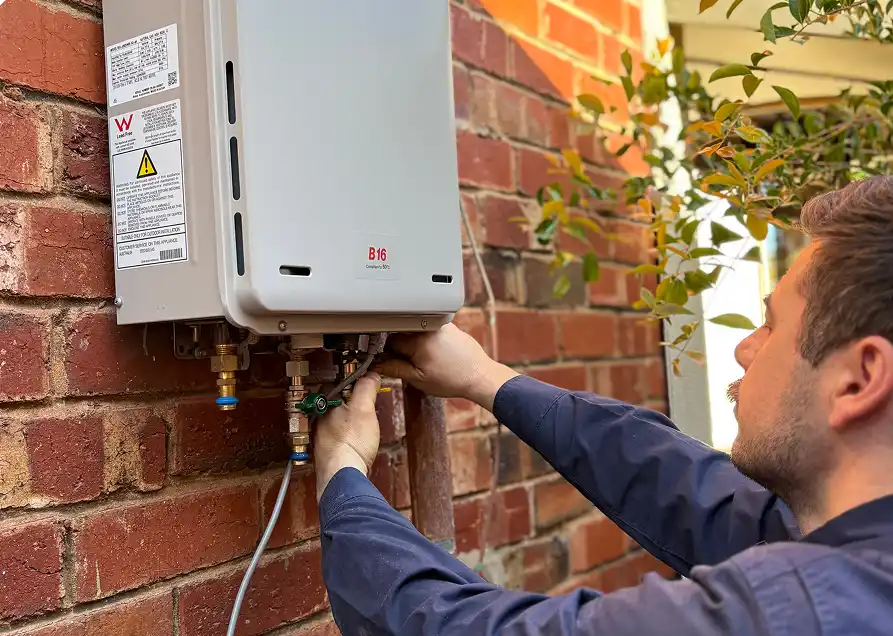
Most Adelaide hot water faults are a failed element, thermostat, thermocouple or valve, and those are repairs, not replacements. The exception is a tank leaking from the cylinder itself: that is always a replacement. The practical threshold is age. Under 8 years, repair. Over 12 years, replace. In between, the deciding factors are the condition of the sacrificial anode and how the repair cost compares with a new unit. We repair and replace electric, gas storage, continuous flow, solar and heat pump systems across Adelaide, and Marc texts an arrival time before setting off.
Related: Gas Fitting · Heat Pump Hot Water · General Plumbing & Maintenance
Work out what has actually failed
Hot water systems fail in a small number of predictable ways, and the symptom narrows it down before anyone opens a panel. That matters, because the gap between a small repair and a full replacement is usually decided in the first 10 minutes on site.
| What you are seeing | Most likely cause | Usual outcome |
|---|---|---|
| No hot water at all, gas storage | Pilot out, failed thermocouple, or the gas control valve | Repair |
| No hot water at all, electric | Failed element, failed thermostat, or a tripped safety cut-out | Repair |
| Hot water runs out far faster than it did | Failed lower element, or sediment filling the base of the tank | Repair, then reassess the age |
| Lukewarm water that never gets hot | Thermostat, or a tempering valve failed part-open | Repair |
| Rusty water on the hot side only | Anode exhausted and the tank lining now corroding | Replace, and soon |
| Constant water pooling under the unit | Perforated cylinder | Replace, no exceptions |
| Continuous flow unit runs hot then cold | Undersized gas line, low flow rate, or a fouled heat exchanger | Repair or resize the gas line |
| Banging or kettling inside the tank | Sediment layer boiling against the element | Flush, then reassess the age |
Repair or replace: where the line actually sits
Age decides this more than the fault does. A mild steel, glass-lined storage tank gives 8 to 12 years in Adelaide. Stainless steel goes longer. Continuous flow gas units regularly reach 15 to 20 years because there is no tank to corrode. So the same fault is worth fixing on a young unit and worth walking away from on an old one.
- Replace when the cylinder itself is leaking. There is no repair for a perforated tank at any age.
- Replace when the unit is past 12 years and the fix is more than roughly 40% of a new installed system.
- Replace when the hot water runs rusty, because that is the tank lining, not the plumbing.
- Replace when parts for the model are no longer made, which happens fast on discontinued imported units.
- Repair when the unit is under 8 years old and the fault is an element, thermostat, thermocouple, gas control valve, relief valve or tempering valve.
- Repair when a continuous flow unit throws a fault code. Those units are built to be serviced and parts are widely held.
- Repair when a solar system has lost its pump or controller but the tank and panels are sound. Those components are a small part of an expensive system.
- Repair, then plan, at 8 to 12 years. A minor repair buying another 2 years is good value. A major one on the same unit is not.
The 5 system types, and which suits an Adelaide house
Replacing like for like is the fastest and least disruptive option, and it is often correct. It is not automatically correct. Replacement time is the only practical moment to change fuel type or technology, because the labour is already being paid for.
| System | Suits | The catch |
|---|---|---|
| Electric storage | Controlled load tariffs, and homes with rooftop solar that can heat on a timer through the middle of the day | Expensive on a general tariff with no solar. On controlled load the tank must be sized for a single overnight heat |
| Gas storage | Households wanting fast recovery that already pay a gas supply charge | The daily gas supply charge runs all year, which hurts if this is the last gas appliance in the house |
| Continuous flow gas | Larger households, and homes short on space for a tank | Needs a correctly sized gas line and enough meter capacity. Undersized supply is the usual cause of poor performance |
| Heat pump | Most Adelaide homes, especially with solar PV, using roughly a third of the electricity of a resistive element | Compressor noise and airflow clearances matter on narrow inner-suburban allotments. Efficiency drops on cold mornings |
| Solar with gas or electric boost | North-facing roofs with good exposure and room for panels | Close-coupled units put real weight on the roof, which needs checking on older framing. Frost protection matters above the foothills |
There is an Adelaide point that gets missed. If the house has rooftop solar PV, an electric storage unit on controlled load is heating at 1am on grid power while the panels export to the grid all afternoon. Moving it onto a timer that heats through the solar window is often the largest running-cost improvement available, and fitting a timer is a small job.
Sizing: the number that decides whether you run out
Undersizing is the most common installation mistake and it cannot be fixed afterwards without replacing the unit. Storage is sized in litres held; continuous flow is sized in litres per minute delivered. A water-efficient shower draws roughly 7 to 9 litres per minute, so a 16 L/min unit runs 2 showers and nothing else.
| Household | Electric storage on controlled load | Gas storage | Continuous flow gas |
|---|---|---|---|
| 1 to 2 people | 125L to 160L | 90L to 135L | 16 to 20 L/min |
| 3 to 4 people | 250L to 315L | 135L to 170L | 20 to 26 L/min |
| 5 to 6 people | 315L to 400L | 170L to 200L | 26 to 32 L/min |
Controlled load changes the maths, because a unit that only heats overnight has to store a full day of hot water. That is why an off-peak tank is far larger than a continuous-tariff tank serving the same household. Heat pumps sit in the same bracket for a different reason: they heat slowly and deliberately, so 250L to 280L suits most families where a 160L heat pump would disappoint the last person in the shower.
Peak demand matters more than the daily total. A household of 4 with staggered mornings needs less capacity than a household of 3 where everybody showers between 7am and 7.30am. Count the simultaneous draw, not the occupants.
Efficiency and the rebates available in South Australia
Water heating is typically the largest or second largest energy use in an Australian home, so the gap between technologies compounds. A resistive element turns 1 unit of electricity into 1 unit of heat. A heat pump moves heat rather than making it, delivering roughly 3 to 4 units of heat per unit of electricity. Across a 10 year life that efficiency gap outweighs the difference between the systems up front.
- Small-scale Technology Certificates under the federal Small-scale Renewable Energy Scheme apply to eligible heat pump and solar installations. They are usually assigned to the installer, who takes them off the invoice as an up-front discount.
- The Retailer Energy Productivity Scheme (REPS) is South Australia's own scheme, delivered through energy retailers and their approved providers, with additional support for priority households.
- STC value falls each year as the deeming period shortens toward the scheme's end date, so the same unit installed next year attracts a smaller discount.
- Eligibility turns on what is being replaced, the model installed, and who installs it. Not every unit on the market qualifies.
There is an honest counterpoint. If the hot water unit is the last gas appliance in the house, the daily supply charge is being paid all year for a single appliance. Weigh that ongoing charge against going all-electric before replacing like for like. South Australia has not adopted the electrification rules Victoria applies to hot water replacement, so gas-for-gas remains a legitimate choice here, but it is worth making deliberately.
The brands we repair, and what each does at 10 years
Brand matters less than age, but it decides parts availability and the shape of the failure. We work on all of the major systems installed across Adelaide.
- Rheem: the most common storage unit in Adelaide homes, Australian made, with elements, thermostats and valves held by most suppliers. That availability is why a Rheem repair stays viable on an older unit.
- Vulcan: built in the same Australian factory as Rheem and sharing many service parts, which keeps repair costs sensible.
- Aquamax: stainless steel tanks that outlast mild steel, so the age threshold for repair sits later.
- Dux: now under Noritz ownership, with a large installed base across the inner south. Parts for discontinued models are the constraint.
- Rinnai: dominant in continuous flow. The controller reports a numeric fault code, and that code narrows the fault before anyone removes a panel.
- Bosch: continuous flow and gas storage, widely installed through the 1990s and 2000s. Ignition and water valve components are the usual service items.
The 2 questions worth asking about any brand are whether the tank is mild steel or stainless, and whether service parts are still manufactured. Those answers decide the repair-versus-replace call more reliably than the badge on the front.
Related services
- Heat Pump Hot Water: Heat pump hot water supply, siting and repair across Adelaide. What the running cost really is, where the unit can sensibly go, and when a heat pump is not worth the change.
- Solar Hot Water: Repairs and diagnosis for solar hot water across Adelaide and the Hills: boosters, tempering valves, pumps, controllers, frost protection and evacuated tubes, plus a straight read on when the system is finished.
- Rheem Hot Water Repairs: Repairs to Rheem electric storage, gas storage and continuous flow units across Adelaide, with a straight answer on when the cylinder is beyond saving.
- Rinnai Hot Water Repairs: Diagnosis and repair of Rinnai Infinity continuous flow units across Adelaide. Fault codes read properly, gas and water sorted on the same visit by a licensed gas fitter.
- Dux Hot Water Repairs: Repairs to Dux electric, gas, solar and heat pump hot water units across Adelaide. We read the compliance plate first, because on a Dux it settles the anode, warranty and parts questions at once.
- Bosch Hot Water Repairs: Continuous flow gas repairs by a licensed gas fitter. Ignition faults, flow sensors, blocked inlet filters and hard-water scale on Bosch units across Adelaide.
- Vulcan Hot Water Repairs: Gas storage repairs by a licensed gas fitter. Pilot lights that will not hold, tripped cut-outs, failed gas control valves and anode checks on Vulcan tanks across Adelaide.
- Aquamax Hot Water Repairs: Electric storage diagnosis on Aquamax tanks across Adelaide. Elements, thermostats, cut-outs, relief and tempering valves, plus a straight answer on stainless tanks and anodes.
Questions we get asked
Who do I call if my hot water system isn't working?
A licensed plumber, and a licensed gas fitter as well if the unit runs on gas. In South Australia both trades are licensed through Consumer and Business Services, and gas work also requires a Certificate of Compliance. Call the plumber first: the fault sits inside the unit far more often than in the supply to it.
Is it worth it to repair a hot water heater?
Under 8 years old, almost always yes. Over 12 years, almost never. In between, compare the repair against roughly 40% of a new installed unit and check the tank type: mild steel glass-lined tanks give 8 to 12 years in Adelaide, stainless steel considerably longer. The only absolute is a leaking cylinder, which cannot be repaired at any age.
What is the most common cause of problems in a hot water heating system?
On electric storage, a failed heating element or thermostat, usually accelerated by sediment building in the base of the tank. On gas storage, the pilot assembly and thermocouple. On continuous flow, an ignition fault or an undersized gas supply. Underneath most of them sits the same root cause: a sacrificial anode that was never replaced. The anode corrodes so the tank does not, and once it is gone the tank starts corroding on schedule.
Do plumbers fix hot water?
Yes. Hot water is core plumbing work, and gas hot water is core gas fitting work. A licensed plumber and gas fitter can diagnose, repair, replace, resize and certify the installation. Marc holds both licences, so a gas unit does not need 2 separate trades attending on 2 separate days.
How long does a hot water system last in Adelaide?
A mild steel, glass-lined storage tank typically gives 8 to 12 years. Stainless steel tanks commonly reach 15 to 20 years, and continuous flow gas units regularly do the same because there is no tank to corrode. Replacing the sacrificial anode roughly every 5 years does more to extend the life of a storage tank than anything else, and it is the maintenance almost nobody does.
Why does my hot water run out so quickly all of a sudden?
On a twin-element electric unit the lower element has almost certainly failed, so only the top third of the tank is heated. That is a repair, not a replacement. The other common cause is sediment occupying the bottom of the tank and displacing usable volume, which shows up alongside a rumbling or kettling noise while it heats. Both are diagnosable on the first visit.
How hot should my hot water be?
Stored water needs to sit at 60 degrees or above to suppress legionella bacteria, and water delivered to bathroom outlets must be limited to 50 degrees for scald protection. That limiting is what the tempering valve does. If your shower has become scalding, the tempering valve has likely failed and it is a straightforward replacement. If the stored temperature was turned down below 60 degrees to save money, turn it back up: that is a health issue, not an efficiency one.
Can I replace a gas hot water system with a heat pump?
Yes, and it is a common Adelaide upgrade, particularly on homes with rooftop solar. It is more than a swap: the heat pump needs an electrical circuit, a position with clearance for airflow and compressor noise, and condensate drainage. Where it replaces an off-peak electric unit, the controlled load wiring usually needs changing so it can run during the solar window rather than overnight. Federal STCs and South Australian REPS incentives commonly apply, which narrows the price gap considerably.
Suburbs we cover for hot water
You might also find this useful
- Is It Worth Repairing a Hot Water System, or Replacing It?The repair-or-replace call comes down to the age of the unit and what has failed, not to how anyone feels about your system. Here are the faults always worth fixing, the faults never worth fixing, and the running-cost argument that changes the answer for anyone with solar panels.
- Hot Water System Leaking? Where the Water Comes From Decides the FixA leak from the relief valve, a fitting, the tempering valve and the tank body all look the same on a wet floor and mean completely different things. Here is how to tell them apart in 30 minutes, and what to shut off in the meantime.
- Sacrificial Anode Replacement: How Often, and When It Is Not Worth DoingThe rod that corrodes so your tank does not. How often it actually needs changing in Adelaide, what shortens the interval, and the cases where replacing it is money thrown at the wrong problem.
- Electric vs Gas Hot Water in Adelaide: What Each One Actually Costs to RunThe arithmetic behind the argument, done with South Australian conditions rather than national averages: what each system draws, how the running costs compare, and the daily supply charge that quietly decides the whole thing.
- How to Relight a Gas Hot Water Pilot Light Safely (and When to Stop)The correct sequence, the flame colours that mean stop immediately, the 2 causes that account for most Adelaide pilot outages, and a clear line where you put the matches down and call a licensed gas fitter.
- Gas FittingLicensed gas fitting across Adelaide: leak detection and repair, appliance and cooktop installation, heater servicing with carbon monoxide checks, and Certificates of Compliance.