
Licensed Gas Fitter in Adelaide: Leaks, Compliance and Appliance Installation
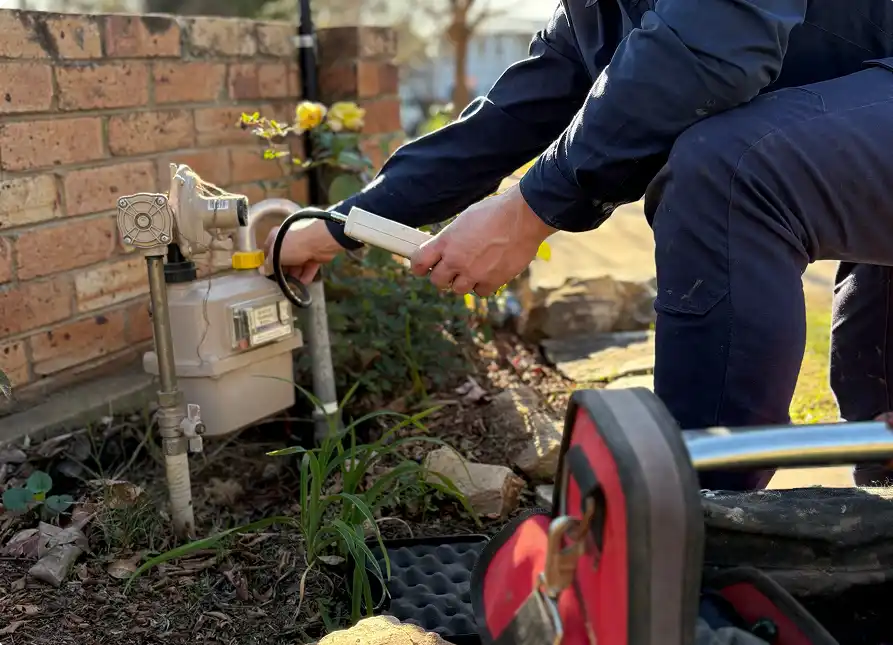
If you can smell gas, turn the gas off at the meter, open the doors and windows, leave the switches and lights alone, get everyone outside, and ring the 24 hour gas emergency line printed on your gas bill. That call is free and it is the right first call, not a plumber. Once the leak is made safe at the meter, repairing your own pipework and appliances is licensed gas fitting work. Marc is a licensed plumber and gas fitter with 20 years experience, and every gas job we complete comes with the Certificate of Compliance South Australian law requires.
Related: Hot Water · Emergency Plumbing · General Plumbing & Maintenance
If you can smell gas right now
Natural gas has no natural smell. The rotten egg odour is an odorant added specifically so a leak announces itself, so if you can smell it, you have found one. Work through this in order and do not stop to investigate.
- Turn the gas off at the meter. The main gas cock is a lever or tap on the pipe at the meter, and a quarter turn so it sits across the pipe is off.
- Open the doors and windows to ventilate.
- Do not operate any switch, light, garage door, fan or appliance. No lighters, no matches, no smoking.
- Leave any mobile phone call until you are outside and away from the building.
- Get everyone, including pets, out of the building.
- Ring the 24 hour gas emergency line printed on your gas bill. In South Australia the distribution network is run by Australian Gas Networks, and their emergency response attends leaks free of charge.
- Stay outside until you are told the building is safe to re-enter.
There is a practical difference worth knowing on a sloping Adelaide Hills block. LPG is heavier than air and pools in low ground, undercroft spaces, pits and cellars, while natural gas is lighter than air and rises. With LPG, do not go searching the lowest space on the property, and ventilate at ground level rather than only up high.
How a gas leak is actually found
Finding a leak is elimination carried out with a manometer, not a guess made with a nose. The installation is pressure tested at the test point with every appliance isolated and the gauge watched over a set period. A pressure drop proves there is an escape. The installation is then split section by section and retested until the drop narrows to a single section, at which point the joints in it are tested with leak detection fluid or an electronic detector.
That sequence is what separates a located leak from a replaced pipe. Isolating and retesting section by section is how the fault gets pinned to one length of pipe, and it is why whole-of-house gas pipe replacement is rarely the right answer in an Adelaide home.
- Threaded black steel joints in pre-1980s homes, where the jointing compound has hardened and shrunk over 40 years. The most common source in the inner suburbs.
- Redundant capped points left behind when an old heater, wall furnace or cooker was removed and the capping was done casually.
- Perished flexible connection hoses behind a freestanding cooker, failing where the hose flexes each time the cooker is pulled out.
- Buried copper runs corroding in reactive clay, particularly where the pipe crosses a garden bed that gets watered.
- Appliance internal faults, which show up as a smell only while the appliance runs rather than constantly.
- Loose or damaged bayonet fittings on a heater point, which leak only when the bayonet is connected.
Licensing and the Certificate of Compliance
Gas work in South Australia is regulated more tightly than most people realise, and knowing the framework protects you. Gas fitters are licensed through Consumer and Business Services, installations are regulated by the Office of the Technical Regulator, and the technical requirements sit in AS/NZS 5601.1.
A licensed gas fitter must issue a Certificate of Compliance for gas installation work. Keep your copy, because it gets asked for in 3 situations that arrive without warning: an insurance claim after a fire or appliance incident, the sale of the property, and any appliance warranty claim, since most manufacturers void warranty on a non-compliant installation.
- Marc is licensed for gas fitting through Consumer and Business Services, and you are welcome to check the licence on their public register. It is free and takes a minute.
- We confirm the Certificate of Compliance is coming before work starts, not after.
- Handyman gas work is illegal, uninsurable and genuinely dangerous. There is no minor gas work exemption in South Australia the way there is for changing a tap washer.
Appliance installation: what makes an install pass or fail
Installing a gas appliance is mostly a compliance exercise, and the failures are predictable. Clearances to combustible surfaces, ventilation for the room, flue terminal position relative to windows, openings and boundaries, an accessible isolation valve at the appliance, and a gas line actually sized for the load: those 5 items account for the overwhelming majority of defective installations.
Line sizing bites hardest in Adelaide, because so many homes have had appliances added piecemeal over decades. Every appliance has a consumption rating in megajoules per hour, and the pipe must be sized for the total connected load across the run involved. A 4 burner cooktop is a modest load. A large continuous flow hot water unit is several times that. Bolt the second onto a line sized for the first and both work alone, then the hot water goes cold the moment someone lights the cooktop.
- Total the connected load in megajoules per hour before choosing the appliance, not after it is delivered.
- Check meter and regulator capacity. Where the load exceeds it, the distributor has to upgrade the meter, which needs organising before the install date.
- Confirm the appliance is certified for the gas type at the property. Natural gas and LPG appliances are not interchangeable without a conversion.
- Check flue terminal clearances before committing to a wall position. This is what forces a hot water unit to be relocated mid-install.
- Commission properly: pressure test, operating pressure measured at the appliance test point, combustion check, and a flue spillage test on any flued appliance.
Carbon monoxide, open-flued heaters and servicing
A gas leak is the risk people worry about. Carbon monoxide from a poorly burning or poorly flued appliance is the risk that actually causes harm, because it has no smell and its early symptoms look exactly like a winter virus. Headaches, nausea, tiredness or dizziness that appear when the heater runs and clear when you leave the house are the pattern to take seriously.
The specific hazard is spillage from an open-flued heater. That appliance draws air from the room and vents through a flue, which depends on the room not being under negative pressure. Modern homes are full of things that create it: a rangehood, a bathroom exhaust fan, a ducted evaporative cooler run in negative mode. Run any of those while an open-flued heater burns in a sealed room and combustion products can be pulled back into the room instead of up the flue.
- Have gas heaters serviced roughly every 2 years, which is the interval the servicing standard sets and most manufacturers require to keep a warranty alive.
- Insist a service on an open-flued heater includes a negative pressure and spillage test with the exhaust fans running, not just a clean and a light.
- Look at the flame. Crisp blue is correct. Yellow, lazy or sooty flames, or soot marks around the appliance, mean stop using it and get it checked.
- Fit a carbon monoxide alarm as a backstop, not a substitute for servicing. An alarm tells you the appliance has already failed.
LPG in the Adelaide Hills
Reticulated natural gas covers the metropolitan plains and thins out quickly through the hills face and beyond. Plenty of properties at Upper Sturt, Aldgate, Bridgewater, Woodside and out toward Nairne run on LPG from bottles or a bulk tank, and LPG behaves differently enough to change the work.
- Each appliance is certified for a specific gas type. Converting between natural gas and LPG means changing injectors and the regulator setting, and a conversion kit is not made for every model. Check before buying a second-hand appliance.
- Cylinder valve and connection types have changed in recent years, so a regulator that served a property for a decade will not always connect to a newly exchanged bottle.
- Automatic changeover regulators are worth the modest extra on twin bottles, because supply switches without anyone noticing the first bottle ran out mid-shower.
- LPG pools in low points, so bottle siting, drainage away from pits and undercroft areas, and clearance from ignition sources matter more on a steep block than a flat one.
- Bushfire-zone properties carry additional requirements for siting and protecting cylinders and tanks. Check those against the property's current overlay rather than how it was installed 20 years ago.
The Hills are a genuine drive from the Westbourne Park base and we say so rather than pretending otherwise. What you get instead of a promise of 20 minutes is a text with a realistic arrival time before Marc sets off, so you are not holding a whole morning open.
When you do not need a gas fitter
Some of the calls we get are not gas fitting jobs at all, and the honest answer saves you a visit.
- Swapping a BBQ bottle is not licensed work. Connect it hand tight, brush the joint with soapy water, and look for bubbles.
- A pilot that blew out once on a windy night usually just needs relighting to the instructions on the appliance. If it keeps going out, that is a thermocouple and it is a job.
- A sulphur smell near an unused floor waste is usually a dry trap, not gas. Pour a bucket of water down it and see whether the smell goes.
- A gas cooktop with a burner that will not light usually has a blocked burner cap or crown. Take it off, clear it, dry it fully and refit it square.
- If the hot water unit is the last gas appliance in the house, the daily supply charge is being paid all year for a single appliance. Weigh that against going all-electric before replacing like for like. Sometimes the right job is disconnecting the gas, not renewing it.
Questions we get asked
What should I do if I smell gas in the house?
Turn the gas off at the meter with a quarter turn of the main gas cock, open the doors and windows, and do not touch any switch, light, fan or garage door. Get everyone outside, then ring the 24 hour gas emergency line printed on your gas bill from outside the building. The distributor attends free of charge and makes the meter safe. Repairing the pipework or appliance afterwards is licensed gas fitting work, and the gas stays off until that is done and certified.
Do I need a licensed gas fitter to install a gas cooktop?
Yes. Connecting any appliance to a gas supply is licensed work in South Australia, including a straight swap onto an existing point. There is no minor gas work exemption. Unlicensed gas work is illegal, it voids the appliance warranty, and it gives an insurer a clean reason to decline a claim after a fire. Marc holds a gas fitting licence and you are welcome to check it on the Consumer and Business Services register before we start.
What is a gas Certificate of Compliance and do I get a copy?
It is the document a licensed gas fitter issues certifying that the installation work complies with the gas installations standard. Yes, you get a copy, and you should keep it with the appliance manual. It is what an insurer asks for after an incident, what a conveyancer asks for at sale, and what a manufacturer asks for on a warranty claim. We issue yours as part of every gas installation job we complete.
How often should a gas heater be serviced?
Roughly every 2 years. That is the interval the servicing standard sets, and most manufacturers require it to keep a warranty alive. On an open-flued heater the service must include a negative pressure and spillage test carried out with the rangehood and exhaust fans running, because that is the condition under which combustion products get drawn back into the room. A service that is only a clean and a light has not tested the thing that matters.
Can I convert an appliance from natural gas to LPG?
Sometimes. It means changing the injectors and resetting the regulator to the correct operating pressure for the gas type, and the manufacturer has to make a conversion kit for that model. Many do, some do not, and no kit exists for a lot of older or imported appliances. Never run an appliance on the wrong gas type: the operating pressures differ by more than double, and the result is either a dangerously rich flame or an appliance that will not stay alight.
Why does my hot water go cold when someone turns on the cooktop?
That is almost always an undersized gas line rather than a faulty appliance. Each appliance has a consumption rating in megajoules per hour, and the pipe has to carry the total connected load over the run length involved. When a large continuous flow hot water unit is added to a line originally sized for a cooktop, both appliances work alone and neither works properly together. The fix is upsizing the affected section, and occasionally a meter capacity upgrade through the distributor.
Is an unflued portable gas heater safe to use indoors?
An unflued heater vents every combustion product into the room you are sitting in, including water vapour, nitrogen dioxide and carbon monoxide. Where one is used it must be in a well ventilated room with a window or permanent vent open, never in a bedroom or bathroom, and never overnight while people sleep. Outdoor patio heaters and BBQs must never be used indoors or in a garage, including with the door open. A flued or electric heater is the better answer in any room used for long periods.
Suburbs we cover for gas fitting
You might also find this useful
- The 5 Silent Signs of a Gas Leak in Your Home, and What to Do FirstRotten egg odour, a hiss at a fitting, dead grass in a line, yellow flames and a bill that climbed. What each sign means, the order to act in, and the 3 things that smell like gas but are not.
- How Often to Service a Gas Heater in Adelaide, and What a Real Service IncludesEvery 2 years for most gas heaters, annually for open-flued units and anything past 15 years. What a proper service actually tests, why the spillage test matters most, and the point where replacing beats servicing.
- How to Relight a Gas Hot Water Pilot Light Safely (and When to Stop)The correct sequence, the flame colours that mean stop immediately, the 2 causes that account for most Adelaide pilot outages, and a clear line where you put the matches down and call a licensed gas fitter.
- Electric vs Gas Hot Water in Adelaide: What Each One Actually Costs to RunThe arithmetic behind the argument, done with South Australian conditions rather than national averages: what each system draws, how the running costs compare, and the daily supply charge that quietly decides the whole thing.
- Hot WaterRepairs and replacements for electric, gas, solar and heat pump hot water systems across Adelaide, with a straight answer on whether the unit is worth fixing.
- Emergency PlumbingEmergency plumbing across Adelaide, 24/7. Burst pipes, sewage backing up, gas leaks and failed hot water, attended by a licensed plumber and gas fitter with the price discussed before work starts.