
The Overflow Relief Gully: What It Is, and Why Yours Is Blocked
An overflow relief gully is the grated drain outside your bathroom or laundry wall, and it exists so that a blocked sewer surges into the garden instead of up through your shower. If it is overflowing, it is working. Stop using every tap, toilet and appliance in the house immediately, keep people and pets away from the water, and do not lever the grate down or seal it. The grate must sit lower than the lowest fixture indoors and proud of the surrounding ground. Landscaping that buried it is the most common reason Adelaide homes flood internally instead.
Need this sorted rather than explained? Blocked Drains in Adelaide. Also worth reading: Tree Roots in Pipes: The Adelaide Guide to Stopping the Damage · Why Do My Drains Smell Like Rotten Eggs, and How Do You Fix It?
What an overflow relief gully actually does
Every sewered property in South Australia has a deliberate weak point built into its drainage, and the overflow relief gully is it. You will find it outside, at ground level, usually within a metre or 2 of an external bathroom or laundry wall: a round or square grate sitting in a short vertical riser, with a water-filled trap below it.
The design is simple and it is the whole point of the fitting. When something blocks the sanitary drain downstream, waste water backs up and looks for the lowest opening it can find. If the ORG is correctly installed, that opening is the ORG, so the grate lifts and the discharge goes into the garden. If the ORG is buried, concreted over or set too high, the lowest opening becomes the shower floor waste, the laundry gully or the toilet, and the discharge goes into the house.
That is worth restating plainly, because it changes how alarming the situation feels. Sewage in the garden is not a failure of the plumbing. It is the plumbing succeeding. The failure is the blockage further down the line, and the ORG has just told you about it in the least destructive way available.
- The grate: loose-fitting by design, so it can lift under pressure. A grate that cannot lift is not a grate, it is a lid.
- The riser: the short vertical section between the grate and the drain, which sets the height at which the system relieves.
- The trap: a water seal below, which stops sewer gas coming up through the grate in normal use. This is why a long-unused ORG can smell in a dry February, once the trap has evaporated.
- The surrounding ground: it needs to fall away from the gully so rain runs off rather than in, and it needs to be somewhere a discharge can safely go.
If it is overflowing right now
The first minute matters more than anything else on this page, and the correct action is counterintuitive: do less, not more.
- Stop using water anywhere in the house. No toilets, no showers, no taps, and stop the washing machine and dishwasher mid-cycle. Everything that goes down a drain now has to come out of that gully.
- Keep children and pets away from the wet area and off any lawn the discharge has reached. Treat it as contaminated, because it is.
- Do not lever the grate down, weigh it with a brick or block it with a towel. Holding it shut does not stop the water, it just redirects it to the next lowest opening, which is inside your house.
- Do not pour drain cleaner into it. Caustic products sit in a full drain doing nothing to the blockage, and they turn a routine jetting job into a hazardous one for whoever opens it next.
- Look at where the water is going. If it is heading toward a doorway, a subfloor vent or a neighbouring property, a sandbag or a bag of potting mix diverting it across the yard is useful. Damming it is not.
- Call a plumber, and mention that the ORG is surging. That single detail tells them the blockage is in the main sanitary line downstream of the gully rather than in a branch, and it changes what goes on the truck.
Finding yours, and checking it is installed correctly
Go outside and walk the external wall of the bathroom, the laundry and the toilet. You are looking for a grate at ground level, usually 100mm to 150mm across, often in a small dished area of paving or a patch of gravel. On older properties it may be cast iron and rusted to the colour of the soil around it. On anything built or renovated since the 1990s it is more likely a PVC grate, sometimes black, sometimes a grey or terracotta colour chosen to disappear.
Do not confuse it with a stormwater pit. Stormwater grates sit at the bottom of downpipes and in low points of driveways and lawns, and they are usually larger, with a wider spacing between bars. An ORG is close to the house, close to a wet area, and connected to the sewer. Anything discharging rainwater into it is an illegal connection and a problem in its own right.
Once you have found it, 2 checks tell you almost everything. The first is whether the grate lifts freely by hand. It should, easily. The second is a bucket test: tip a bucket of clean water into it and watch. Water that vanishes immediately means the drain below is running clear. Water that pools, drains slowly, or rises before it falls means the line downstream is already partly restricted, and you have found a blockage before it found you.
The height rules are where most published advice, including the earlier version of this article, gets loose with the figures. The principle is what matters and it is not negotiable: the grate must be lower than the lowest fixture inside the building, so that the gully relieves first, and it must sit proud of the surrounding finished ground, so that rain and garden runoff cannot enter the sewer. The clearances applied under AS/NZS 3500.2 for sanitary plumbing and drainage are commonly quoted as at least 150mm below the lowest fixture and at least 75mm above the finished surface level, but installations vary by age and by the requirements in force at the time. Treat those numbers as the check to make rather than the law to quote, and have a licensed plumber confirm your own installation.
Why Adelaide gullies end up buried, blocked and painted over
Adelaide has a specific version of this problem and it is worth understanding, because it is almost never the original plumber who caused it. It is 3 successive waves of renovation, each of which raised the ground around a fitting whose entire function depends on being the low point.
The first wave was the concrete of the 1970s and 1980s: paths poured around the house, a slab under a new carport, a concrete apron along the laundry wall. Plenty of ORGs from that era were simply poured around, or over. The second was the paving and decking boom from the 1990s onward, which added 40mm to 80mm of ground level over a single weekend across the side and rear of thousands of houses. The third is current: raised garden beds, artificial turf laid over a compacted base, and decorative pebble, all of which quietly lift the surface by another 50mm or more.
The postwar brick and tile suburbs suffer worst, and Panorama, Pasadena, Ascot Park, Park Holme and Oaklands Park are full of examples. Those houses were built with the gully at or barely above the original ground level to begin with, so they had no margin to lose. The inner south has its own version: on the narrow allotments through Goodwood, Millswood, Black Forest and Clarence Park the ORG frequently sits in a side passage barely a metre wide, which is exactly where later owners put a paved path, a garden shed on a concrete pad or a carport slab.
Adelaide soil adds a slower version of the same effect. The reactive clays across the inner south and the hills face swell through winter and shrink through summer, moving the ground surface seasonally and, over decades, permanently. A gully installed with a legitimate clearance in 1962 can be marginal today without anyone having built anything at all.
Then there is what actually blocks the line below. The gully itself rarely fails on its own: it is the drain downstream that gives out, and in Adelaide that is overwhelmingly tree roots entering vitrified clay sewer joints, with fat and wipes catching on the root mass and turning a partial restriction into a complete one. A drain that blocks around the same months each year is not being overused. That is seasonal root intrusion, and the ORG surging is the last symptom in a sequence that started with a gurgle.
- Grate rusted or concreted into the riser, so it cannot lift under pressure.
- Ground level raised by paving, decking, turf or garden beds until the grate is at or below the surrounding surface.
- Silt, leaf litter and garden mulch filling the gully and its trap.
- Roots, fat and wipes blocking the sanitary drain downstream of the gully.
- Downpipes, pool backwash lines or a laundry sink discharging stormwater into the gully, which overloads the sewer in heavy rain and is not permitted.
- A trap that has dried out over summer, which does not block anything but does let sewer gas straight into the yard.
Whose blockage is it, yours or SA Water's
This is the question that decides who pays, and it catches a lot of Adelaide homeowners out, because the dividing line is not the front fence. SA Water owns and maintains the sewer main and the connection point that serves your property. Everything from that connection point back to the house, the private sanitary drain, belongs to the property owner. On many older Adelaide properties the connection point sits inside the boundary, sometimes well inside it, so a length of pipe on your own land can still be SA Water's asset, and a length under the footpath can still be yours.
- Blockage in the SA Water main or at the connection point: SA Water attends and clears it, and it is not charged to you. Their 24 hour line is 1300 SA WATER (1300 729 283).
- Blockage in the private drain between the house and the connection point: the property owner's responsibility and the property owner's cost.
- Several properties in the street affected at once, or discharge surfacing in the road or the nature strip: that pattern points to the main, so call SA Water first before paying anyone.
- Only your property affected, with the ORG surging: that pattern points to the private drain, and a plumber is the right call.
- Renting: the tenant reports it, the landlord or agent arranges and pays for it, unless the blockage was clearly caused by what went down the drain.
Establishing which side of that line the defect sits on is a legitimate part of the job, not an extra. A CCTV inspection with a sonde locator puts a measured distance and a depth on the fault from a fixed point at the surface, and that is what settles the question. We locate the defect as part of clearing the blockage, so you finish the visit knowing where it was, what caused it and whose asset it sits in.
What clearing it properly involves
The ORG is usually the access point, which is convenient, because it is a straight shot into the main sanitary line. Removing the grate gives a jetter or a drain machine direct entry without lifting paving or opening a boundary trap.
- The gully and trap are cleared of silt, leaf litter and debris by hand first, so nothing gets pushed further into the drain.
- The line is cleared. High pressure water jetting with a root-cutting head is the method of choice for a root blockage, because it cuts the mass out and scours the pipe wall rather than punching a hole through the middle of it.
- The line is filmed with a CCTV camera once it runs clear, which is the only way to see what actually caused the blockage and whether the pipe itself is damaged.
- Defects are located and measured from the surface with a sonde locator, so their position and depth are recorded against a fixed reference point.
- The gully installation is checked: does the grate lift, is it the low point relative to the fixtures inside, is anything discharging into it that should not be.
- You are told what was found, shown the footage, and given the reasoning behind whatever comes next.
The distinction between clearing and fixing is the one that saves money over 5 years. Machine clearing a root blockage restores flow and buys a season, sometimes 2. It does not close the joint the roots came in through. Whether that matters depends entirely on what the camera shows: an isolated cracked junction is a different proposition to a run of open joints along the whole length, and the honest answer sometimes really is to keep clearing it every couple of years rather than to spend on a repair. That judgement belongs with the footage in front of you.
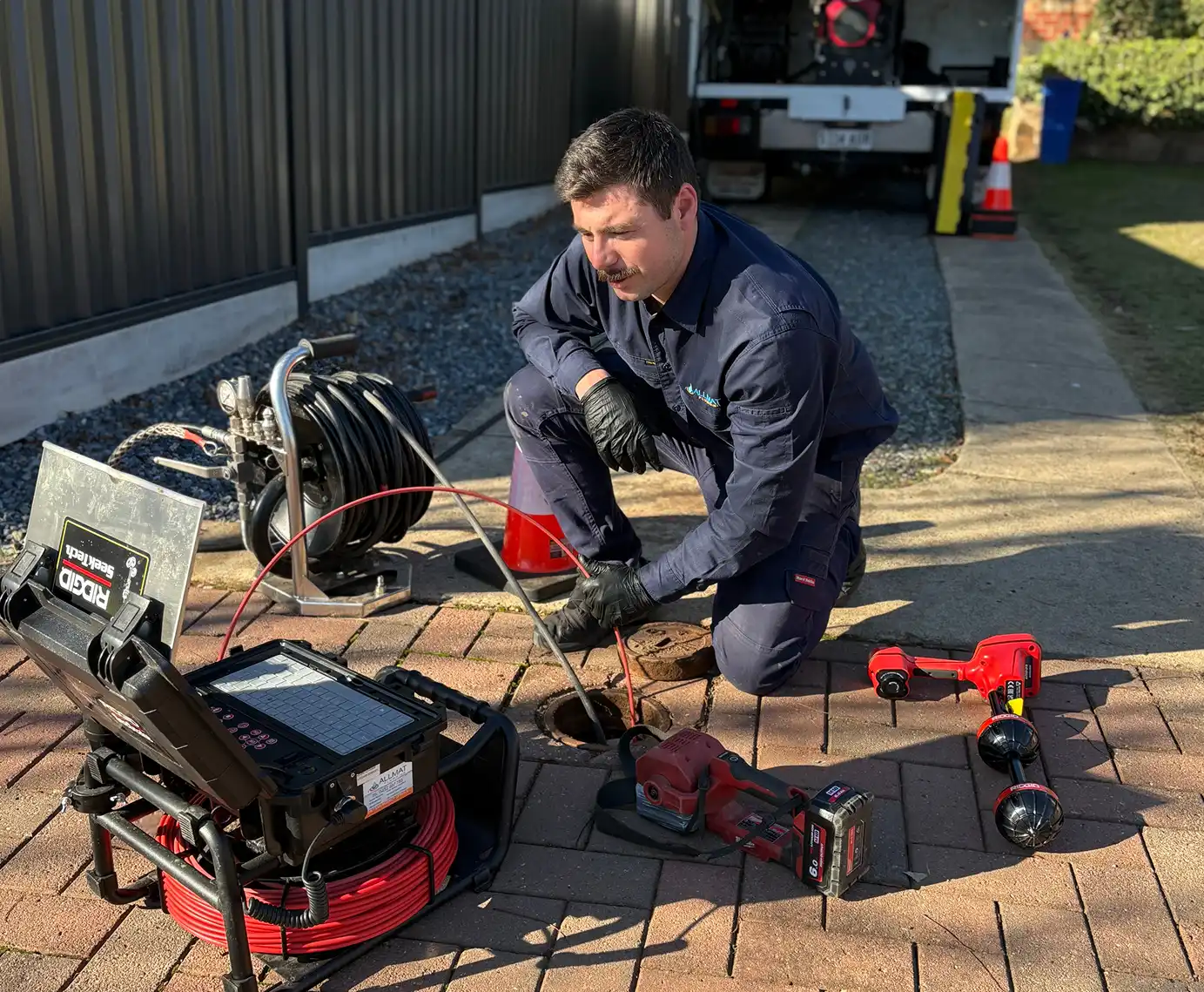
Allmat runs a Jetwave jetter and a RIDGID SeeSnake CCTV camera with a locator, both visible in the photographs on this site, so the clear and the inspection happen on the same visit rather than as 2 separate callouts.
Keeping it working, and when you do not need a plumber
Plenty of ORG problems are maintenance rather than plumbing, and saying so costs a job occasionally. It is still the right thing to say.
- Clear leaf litter, mulch and silt out of the gully by hand a couple of times a year, especially after autumn. Gloves, a trowel, 5 minutes.
- Tip a bucket of water in afterwards. If it disappears, the drain is fine and you have just confirmed it for free.
- Keep the grate visible and keep the area around it clear. Do not landscape over it, do not stand a pot plant on it, do not lay turf across it.
- Pour a bucket of water down it in late summer if the area smells. That refills a trap that has evaporated, and it costs nothing.
- Never tip fat, oil or food waste into it, never use it to drain a pool or a spa, and keep paint, render washings and tile-cutting slurry out of it during a renovation. Those set hard in the trap.
- If a landscaper, paver or builder is quoting work near the house, point the gully out to them before they start. Reinstating a buried one afterwards costs many times what leaving it exposed would have.
When you do need a plumber is equally clear cut. Discharge coming out of the gully, water that will not clear after a bucket test, gurgling across multiple fixtures, sewage appearing inside the house, a grate that cannot be lifted, or a gully you now suspect is higher than the shower floor inside. Any of those is a licensed plumber's job, and the last one is worth acting on even when nothing is currently wrong, because it is the difference between a mess in the garden and a mess in the hallway.
Allmat covers blocked drains across the inner south, the western suburbs and the Adelaide Hills from a base at Westbourne Park. Marc is a licensed plumber and gas fitter with 20 years of experience, he discusses the price before starting, and he texts an arrival time before he sets off, which matters more than usual when you are standing in the yard waiting and cannot use the toilet.
Questions we get asked
What is an overflow relief gully?
It is a grated drain at ground level outside your bathroom or laundry wall, connected to the sanitary drain, with a loose grate and a water-filled trap below. It is a designed relief point: when the sewer blocks and waste backs up, the grate lifts and the discharge escapes into the garden rather than rising through the shower floor waste or the toilet inside the house. Every sewered property in South Australia should have one, and it should be the lowest opening on the drainage system.
Why is sewage coming out of the drain in my yard?
Because the sanitary drain downstream of that gully is blocked, and the gully is doing exactly what it was installed to do. The discharge is unpleasant but it is in the garden rather than the hallway, which is the entire purpose of the fitting. Stop using water throughout the house immediately, keep people and pets away from the wet area, do not weigh the grate down or block it, and call a plumber. Mentioning that the gully is surging tells them the blockage is in the main line, not a branch.
Can I unblock an overflow relief gully myself?
You can clear the gully itself. Lift the grate, scoop out leaf litter, mulch and silt by hand with gloves on, then tip in a bucket of clean water. If it drains away immediately, the problem was surface debris and you are done. If it pools, holds, or rises before falling, the blockage is in the drain below and that needs a jetter and a camera. Do not pour drain cleaner into it: caustic product sits in a full drain achieving nothing and makes the line hazardous to open.
How high should an overflow relief gully be?
The principle first: the grate must be lower than the lowest fixture inside the building so the gully relieves before the shower does, and it must sit above the surrounding ground so rain and garden runoff cannot enter the sewer. The clearances applied under AS/NZS 3500.2 are commonly cited as at least 150mm below the lowest fixture and at least 75mm above finished ground level, though installations vary with their age and the rules in force when they were built. Have a licensed plumber confirm your own rather than relying on a figure from a website.
Is a blocked sewer SA Water's responsibility or mine?
It depends which side of the connection point the blockage sits on. SA Water maintains the sewer main and the connection, and clears blockages on their side at no charge on 1300 SA WATER (1300 729 283). The private sanitary drain from the connection point back to the house belongs to the property owner. On older Adelaide properties the connection point is often inside the boundary, so location matters more than the fence line. If several houses in the street are affected at once, call SA Water first.
Can I cover or move my overflow relief gully?
Cover it, no. A gully that has been paved over, concreted in, turfed across or had its grate screwed down cannot relieve, and the next blockage will discharge inside the house instead. Moving it is a different question and is sometimes the right answer, particularly where renovation has left it stranded below a new ground level. Relocating or raising a gully is notifiable sanitary plumbing work in South Australia, so it has to be done by a licensed plumber and it has to end up compliant, not just tidier.
References
You might also find this useful
- Blocked DrainsBlocked sewer, toilet, sink and stormwater drains cleared across Adelaide with a jetter and an electric machine, then filmed with a CCTV camera so you find out what caused it.
- Tree Roots in Pipes: The Adelaide Guide to Stopping the DamageA drain that blocks every year around the same time is not being overused. It is taking tree roots through an open joint. Here is how roots actually get in, which Adelaide trees do it, what each fix genuinely buys you, and the treatments that waste money.
- Why Do My Drains Smell Like Rotten Eggs, and How Do You Fix It?Rotten egg means hydrogen sulphide, and there are only 3 realistic sources in a house. Work out which one you have first, because the fix for a dry trap, a biofilm build-up and a hot water anode have nothing in common.
- Stormwater Drain Maintenance in Adelaide: The Autumn ChecklistAdelaide gets most of its rain between May and September, which means a stormwater system has all summer to silt up before its first real test. Here is the autumn checklist, the faults worth paying to fix, and the ones you can safely leave alone.