
Tree Roots in Pipes: The Adelaide Guide to Stopping the Damage
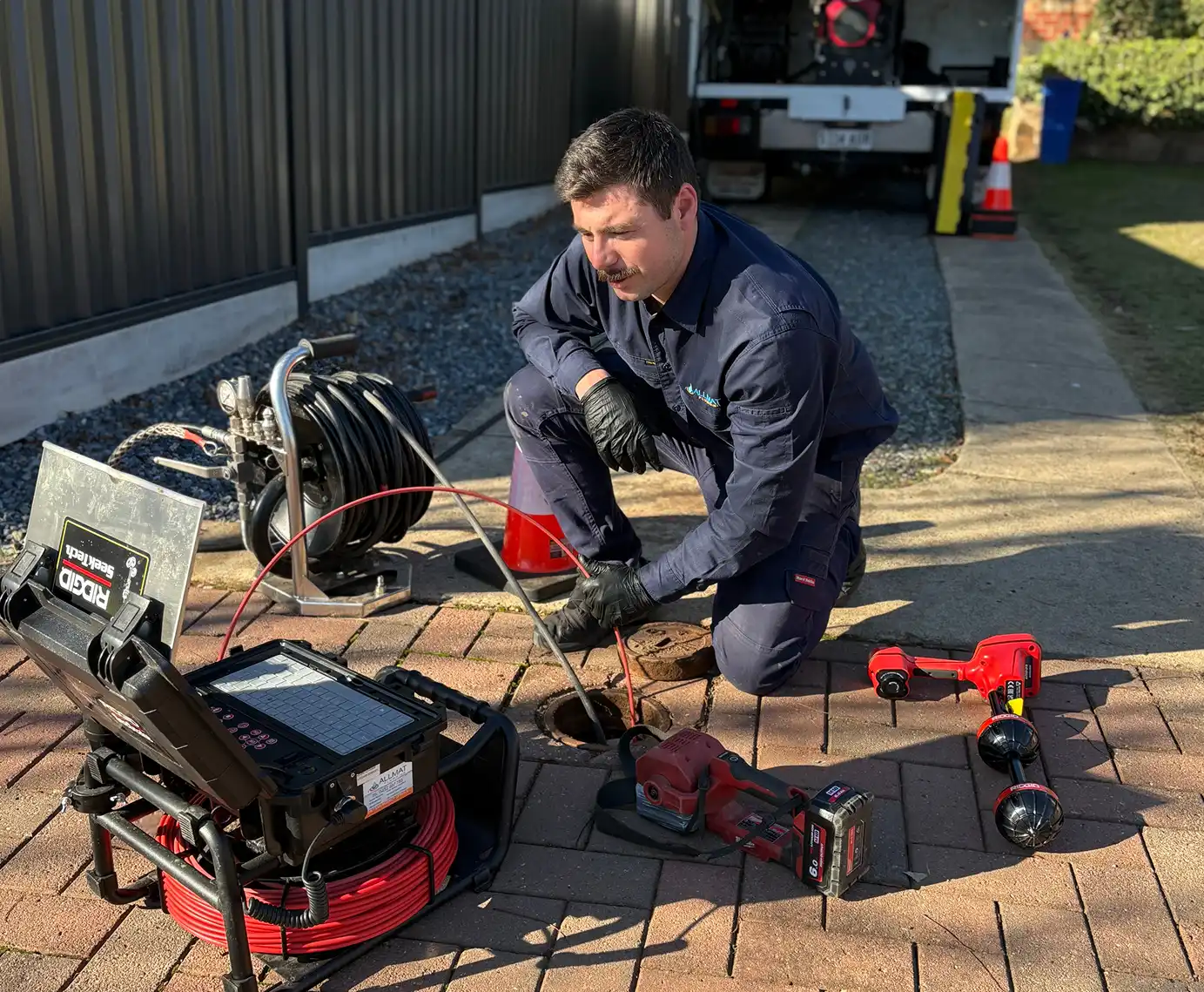
Tree roots enter Adelaide sewers through the mortared joints of old vitrified clay pipe. They do not drill through sound pipe: they follow the moisture escaping an existing defect. The signature is rhythm. A drain that blocks around the same months each year, clears easily, then blocks again is taking roots, not being overused. Clearing buys roughly a season. A CCTV inspection is what settles whether the joint has opened far enough that a patch reline over that joint is the better answer than clearing the same line year after year. Roots cannot re-enter a cured patch liner, because it seals the joint they were using.
Need this sorted rather than explained? Tree Root Removal in Adelaide. Also worth reading: Pipe Relining vs Pipe Replacement: How to Choose the Right Repair · Are Flushable Wipes Really Flushable? What Adelaide Drains Show
The signs, in the order they usually appear
Root intrusion announces itself long before it stops a drain. The mass grows a little each season, so capacity is lost gradually and the household adjusts without noticing. Most people call at stage 4 below. The ones who call at stage 2 pay considerably less.
- The shower or the laundry trough drains a little slower than it used to. Nobody times it, so nobody is sure.
- A sink or floor waste gurgles when the toilet is flushed. That is air being forced past a partial obstruction further down the line.
- The toilet needs a second flush more often than it used to, and the water sits higher in the pan afterwards.
- A blockage. It clears easily with a machine, and everyone concludes the problem is solved.
- The same blockage returns, roughly 6 to 12 months later, at a similar time of year.
- The overflow relief gully outside surcharges, or a wet patch of unusually green grass appears in a line across the yard.
Stage 6 warrants action immediately. A gully that has surcharged is doing its job, which is to release sewage into the garden rather than through your bathroom floor. Soft or sunken ground above the line means the pipe is now taking soil as well as roots, and that is where a relinable defect turns into an excavation.
How roots actually get in, and why Adelaide makes it easy
The common picture is of a root prising a pipe apart. That is not what happens. A root cannot sense a sealed pipe full of water and cannot penetrate sound vitrified clay or PVC. What it can sense, with considerable precision, is a plume of warm moist air escaping into dry soil. A sewer runs warmer than the ground around it, so a hairline crack or an open joint leaks a vapour signature into the soil. Roots grow towards it, arrive as fine hairs, pass through the gap, and thicken inside the pipe where water and nutrient are unlimited.
That mechanism explains the rest: why intrusion is always at a joint and never mid-barrel, why the mass is denser inside the pipe than outside, and why sound PVC beside a large tree stays clear for decades. It also explains the seasonality. Roots hunt hardest through a dry Adelaide summer, so blockages cluster from late summer into autumn rather than in the wet months.
Adelaide then supplies the defects. The inner and inner-southern suburbs were sewered in vitrified clay laid in short lengths with mortared joints, and mortar is rigid, porous and about a century old. Underneath it sits some of the most reactive clay soil in the country, which swells through winter and shrinks hard through summer. Every year that soil works each joint a fraction further open. The pipe barrel is usually still sound. The joints are the failure, and they occur every 600mm or so along the run.
The Adelaide trees that actually do it
Any tree will take an open sewer joint if its roots reach one. Some are dramatically more likely to, because they root aggressively, tolerate compacted urban soil, and grow everywhere across the suburbs Marc works in.
| Species | Where you see it | Why it is a problem |
|---|---|---|
| London plane | Street plantings through Unley, Norwood, Goodwood and Prospect | Vigorous lateral roots, planted directly over the verge where the connection runs |
| Liquidambar | Front gardens across the inner south, planted heavily from the 1960s | Fast growing, with a broad shallow root plate that easily reaches a side-passage drain |
| Camphor laurel | Older established gardens | Extremely vigorous, long lived, and very difficult to control once established |
| Willow and poplar | Creek lines and damp low ground, including the Brown Hill Creek corridor | The most water-seeking of the lot, and the most destructive per metre of pipe |
| Chinese elm and nettle tree | Self-seeds through fence lines and neglected corners | Arrives uninvited, suckers hard, and is frequently the culprit nobody planted |
| Olive | Hills face, from Mitcham to Belair | Deep and persistent, and feral olives regenerate from cut stumps |
| Running bamboo | Boundary screening on infill blocks | Not a tree, and routinely the cause. Rhizomes travel metres and enter joints readily |
Distance is a poor guide. A mature plane tree sends roots well beyond its canopy, and a sewer joint 15 metres away is closer, in root terms, than a watered lawn. What matters far more than the species is whether your drain is leaking somewhere for the roots to find.
How the entry point gets found
Diagnosis has a fixed order and it cannot be shortcut. A camera cannot see through a blocked pipe, so the line is cleared first, then inspected. An inspection carried out while the mass is still in place tells you where the blockage is and nothing about why.
- Clear the line, usually with a jetter running a root-cutting head, or with a mechanical machine where access is tight.
- Run the CCTV camera the full length of the run, from the inspection point out to the boundary.
- Locate each defect from the surface using the sonde in the camera head, which gives a position on the ground and a depth in millimetres.
- Mark those positions. A defect measured from a fixed reference point is a defect anyone can find again in 5 years.
- Where the fault is a leak rather than an obvious break, dye or smoke tracing confirms where water is escaping.
- Review the footage together and decide what, if anything, needs repairing.
Ask for the footage and keep it. It dates the condition of the pipe, it tells the next plumber where to start, and if the property sells it answers a building inspector's questions in about 90 seconds.
Clearing, cutting and relining: what each one actually buys
The choice is not the same for every drain. What matters is the second column, because that is the part that decides whether you are buying a season or a permanent fix. Marc does patch and sectional relining, which repairs the defective joint itself rather than the full length of the drain.
| Approach | What it actually buys |
|---|---|
| Mechanical clear with a drain machine | Flow restored. Cuts a channel through the mass and leaves roots at the wall. Holds 6 to 12 months |
| Hydro jetting with a root-cutting head | Flow restored and the bore cleaned back to the pipe wall. Typically holds 12 to 24 months |
| CCTV inspection with a written report | The information the decision depends on, and a dated record of the condition of the pipe |
| Patch or sectional reline over a single defect | That joint is closed permanently. Roots have nothing left to enter through |
| Excavate and replace a section in PVC | Corrects alignment and grade as well as the defect. The only option once a pipe has collapsed |
Then apply your own history. A line that blocks every year is being cleared every year and still owns the same failing joint, several seasons further open, plus a lost morning each time. A patch reline closes that joint once. A line that has blocked once in 5 years is a different case entirely, and clearing it as it happens is the sensible answer.
What does not work, and what makes it worse
- Copper sulphate crystals flushed down the toilet. They sink and travel along the invert, so they never contact the root mass growing down from the leaking joint above. On septic they also kill the bacteria the tank depends on.
- Salt, bleach or caustic drain cleaner. None of these kill an established root mass, and caustic sitting in the line is a hazard for whoever opens the inspection point next.
- Boiling water. It does nothing to lignified root tissue, and repeated thermal shock is unkind to old clay joints.
- Foaming root retardants applied to a line that has not been cut back first. Products containing dichlobenil work by contacting root hair at the pipe wall, so they are a maintenance step straight after a proper jetting, not a repair, and must be used to the registered label.
- Removing the tree and stopping there. The root mass takes years to break down, the defect that let it in is untouched, and something else will find the same gap.
There is a single genuine preventive measure and it is only available before planting: a physical root barrier, a ribbed impermeable sheet set vertically between the tree and the service run, deep enough that roots deflect down rather than under it. Retrofitting one along an existing sewer means excavating the length you were trying to avoid excavating.
The tree itself: what South Australian rules allow
Most people eventually ask whether the tree can simply go. In South Australia that is a planning question, not a plumbing one, and the thresholds tightened on 16 May 2024. A regulated tree has a single trunk circumference of 1 metre or more, measured 1 metre above natural ground level. A significant tree reaches 2 metres at the same measuring point. Multi-trunk trees are assessed on combined circumference and average trunk size.
Removing or substantially pruning a regulated or significant tree requires development approval, and the grounds are narrow. Damage to a sewer or stormwater drain is not, on its own, generally sufficient. The relevant tests concern risk to a substantial building or structure, tree health, and safety. Worth knowing before you pin your hopes on removal as the simple fix.
If the tree stands on the verge it is council property, and pruning or removing it yourself is not an option. Every metropolitan council runs a street tree request process, and the conversation will be about the tree's condition and amenity value rather than about your drain. Councils across the inner south have spent 30 years building that canopy deliberately.
Questions we get asked
Can tree roots really break a sewer pipe?
Not from the outside, at first. Roots find an existing defect, usually an open mortared joint in old vitrified clay, and enter as fine hairs following the moisture vapour escaping from it. Once inside they thicken, and a root that has grown to the diameter of a thumb inside a joint will absolutely displace the pipe and open the fault further. So roots do end up breaking pipes, but they never start the damage. Something else did.
Who pays if a council street tree has blocked my sewer?
In practice, you do. The drain within your property boundary is the property owner's responsibility regardless of whose tree caused the intrusion, and the argument that would need to be won is that the council was negligent rather than simply the owner of a tree doing what trees do. Councils generally take the position that a sound pipe does not admit roots. That position is technically correct, which is what makes it hard to argue with.
Does copper sulphate kill tree roots in drains?
Not usefully. Crystals flushed down a toilet sink and travel along the bottom of the pipe, while the root mass grows down from the leaking joint at the top, so the 2 rarely meet. Even where there is contact, copper sulphate kills the tissue it touches without removing the mass or closing the entry point. On a septic system it also kills the bacteria the tank relies on. Cutting the roots out mechanically and then dealing with the joint is the only approach that changes anything.
How often will a root-blocked drain need clearing?
Between 6 and 24 months, depending on how it was cleared and how large the defect is. A mechanical machine cuts a channel through the mass and typically buys 6 to 12 months. Jetting with a proper cutting head cleans the bore back to the pipe wall and usually holds 12 to 24 months. Neither closes the gap the roots come through, so the interval shortens over the years as the joint opens.
How far from a sewer line can I safely plant a tree?
There is no distance that is safe on a leaking pipe and no distance that matters on a sound one. As a working rule, keep large vigorous species such as liquidambar, plane, willow, poplar and camphor laurel well clear of a known drain line and choose smaller species near it. The more valuable step is knowing the condition of the pipe. If your drain is 90 year old clay with mortared joints, a modest tree at 10 metres is a genuine risk. If it is sound PVC, a large tree at 3 metres is not.
Does home insurance cover tree root damage to drains?
Usually not for the pipe itself. Most Australian home policies exclude gradual deterioration and root intrusion specifically, which covers almost every case of this kind. Some policies do cover resulting damage, such as water damage inside the house from a surcharge, even where the pipe is excluded. Dated CCTV footage and a written report from a licensed plumber are what an insurer will ask for, so obtain both before any repair work starts.
References
You might also find this useful
- Tree Root RemovalRoot cutting, high pressure jetting and CCTV diagnosis for root-invaded sewer and stormwater drains, with a straight answer on whether a clearing cycle or a permanent repair is the better spend.
- Pipe Relining vs Pipe Replacement: How to Choose the Right RepairPatch relining and excavation are 2 tools for 2 different faults. The pipe conditions that decide it, what the camera has to show before a liner is an option, and when digging is genuinely the better repair.
- Are Flushable Wipes Really Flushable? What Adelaide Drains ShowToilet paper falls apart in minutes. Wipes labelled flushable do not. Here is what the testing found, why Adelaide clay sewers catch them so reliably, and how to tell a wipe blockage from a root blockage.
- Do Supermarket Drain Cleaners Damage Your Pipes?Most pages on this subject say never use them, which readers do not believe because the bottle sometimes works. Here is the accurate version: what is in it, what it damages, the narrow case where it is a fair choice, and the symptoms that mean it will never help.