
Tree Root Removal Adelaide: Getting Roots Out of Sewer Pipes for Good
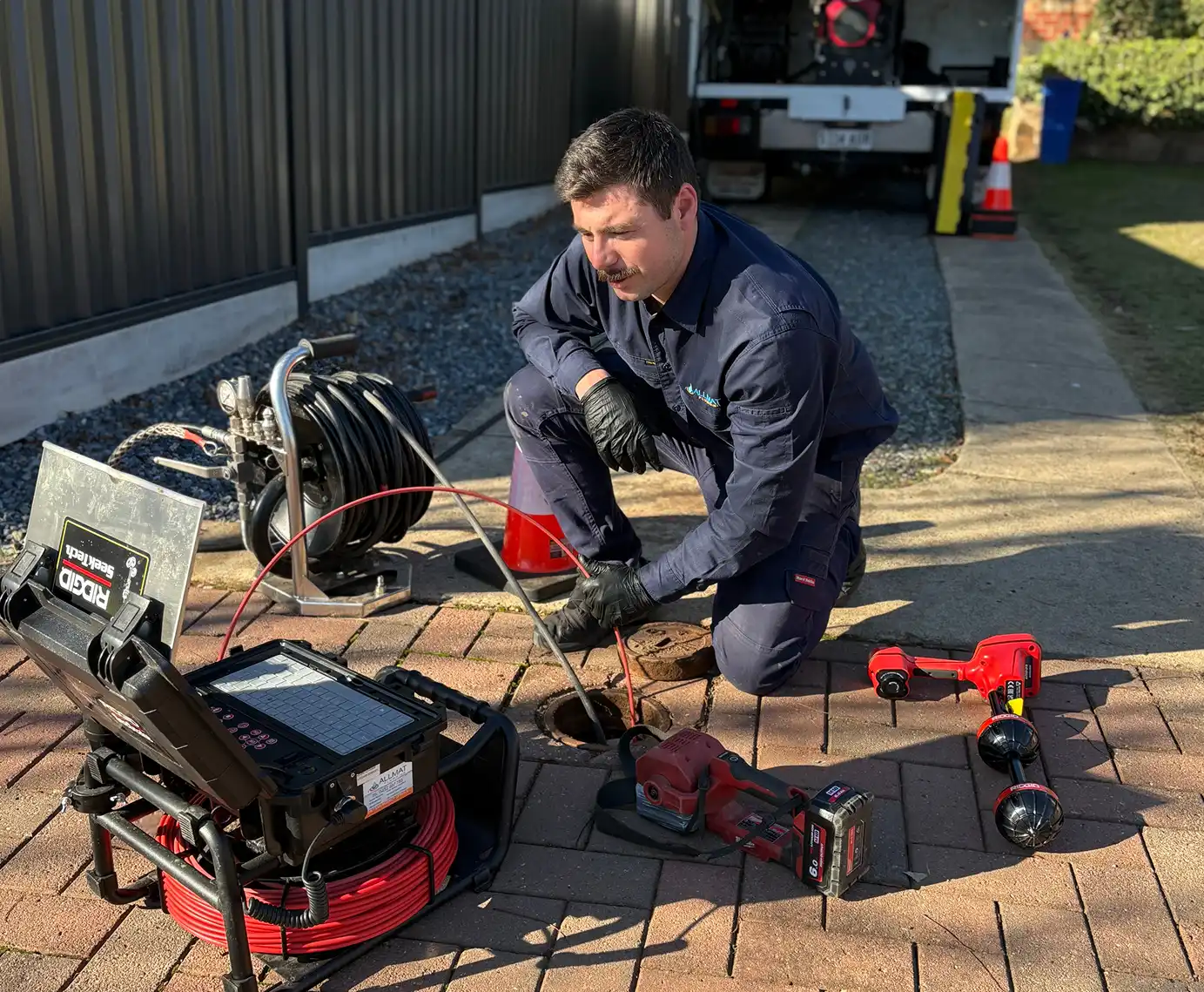
Tree roots do not drill through a sound pipe. They find an existing defect, almost always a perished joint in old vitrified clay, and grow in toward the water and nutrient inside. Removal means cutting the root mass out with a high pressure jetter or an electric eel, then deciding what to do about the opening it came through. Cutting alone is maintenance and buys 12 to 24 months. Closing the defect, with a patch liner over that section or by replacing it, is the repair. A camera inspection is what tells you which of those is the better call.
Related: Blocked Drains · Pipe Relining · CCTV Drain Inspection
How roots get into a sewer that is supposedly sealed
A sewer carries warm water, and warm water in a cold pipe produces vapour. Vapour escaping through the smallest defect creates a plume of moist, nutrient-rich air in the soil, and in an Adelaide February that plume is the most attractive thing in the garden. Fine feeder roots follow the gradient and push through a gap of about a millimetre, then thicken into the mat that stops the drain.
The defect comes first, and in the inner south it is nearly always the same defect. Goodwood, Unley, Malvern, Hyde Park and Norwood were sewered in vitrified clay laid in short lengths with mortared joints. Clay does not rust or rot, so the barrel routinely survives a century. The mortar does not. Add reactive soil that swells in winter and shrinks hard through summer, working those joints for decades, and the openings make themselves.
- Perished mortar joints in vitrified clay: the classic Adelaide entry point.
- Badly made or unsealed junctions, including branches added in a later bathroom renovation.
- Cracks from ground movement, vehicle loading over a driveway, or a section dropped out of alignment.
- Missing or unsealed inspection opening caps, which are an open invitation at ground level.
Roots travel commonly 2 to 3 times the spread of the canopy, so the tree responsible is often not the one over the blockage, and often not on your block. Willow, poplar, liquidambar, fig and large eucalypts are the most aggressive water seekers here. By sheer numbers though, the inner-suburban culprits are the street trees: plane, jacaranda and ornamental pear.
The signs, in the order they usually appear
Root intrusion announces itself gradually, which is why households live with it for years. The sequence is consistent enough to be useful.
- Slow drainage, worst at the fixtures furthest from the street, and a shower emptying more sluggishly than it did last winter.
- Gurgling from a shower or floor waste when the toilet flushes, which is air dragged through a trap because the drain is running full.
- Toilet paper coming back up, or a wad of paper snagging on something when the drain is opened.
- The seasonal pattern: blockages clustering in late summer when roots hunt hardest, and again after the first autumn rain.
- Water standing in the overflow relief gully outside, which is the drain telling you it is blocked rather than the fixture.
- Sewage over a bathroom or laundry floor. By this stage the mat is close to full blockage and the gully has been defeated or buried.
The 3 ways roots get removed, and what each is worth
All 3 methods work. What separates them is how much root is left behind to regrow.
| Method | What it does | Realistic result |
|---|---|---|
| Electric eel with a cutting blade | Spins a blade through the root mass on a flexible cable | Punches a channel rather than clearing the wall, so regrowth is quick |
| Jetting with a root cutting head | Cuts the mass back to the pipe wall and flushes the debris out | Removes rather than perforates, leaving a clean bore for the camera |
| Root foaming treatment | A herbicidal foam expands to contact the full circumference | Slows regrowth for a season or 2. It treats the roots, not the hole |
Cutting roots is pruning, and pruning makes plants grow thicker. Severing a root triggers branching at the cut, so the mass regrowing in that joint is denser than the one removed. That is why 5 rounds of eeling costs more across a decade than fixing the pipe once.
Cutting roots is maintenance. Closing the hole is the repair.
Whether to keep clearing or to close the defect is the real decision on a root-invaded drain, and it is one you can work through yourself once the camera has been in.
Clearing on a cycle never ends. The roots regrow denser at every cut, so the interval shortens and the visits keep coming. A patch liner over the single invaded joint ends it, and it is spread across the remaining life of the drain rather than repeated every year or 2. The repair wins comfortably when the camera shows 1 or 2 defects in an otherwise sound run. That balance reverses in real situations, and they are worth naming.
- The run has open joints along its whole length. Patching 9 of them is not a plan, so that becomes a replacement job rather than a patching one, and clearing on a cycle while you plan for it is legitimate.
- You are selling within a year or 2. Cyclical clearing is rational, provided the drain's history is disclosed honestly to the buyer.
- The defect sits past your boundary. That is SA Water's pipe, and no amount of relining on your side fixes it.
- The intrusion is fine hair roots at 1 joint on a drain that has blocked once in a decade. Clear it, film it, leave it alone. Not everything on a camera needs fixing.
Do you have to remove the tree?
Almost never, and reaching for a chainsaw usually costs a good tree for no drainage benefit. The pipe failed because a joint opened. That joint stays open whether the tree lives or dies, the killed root mass rots inside the pipe rather than vanishing, and the next tree within range finds the same opening. The exception is structural: a large water-seeking species close to a footing on reactive clay drives soil shrinkage in its own right, which is one for an arborist.
- Root barriers work when installed properly: a physical barrier set to the depth of the drain, not plastic in a shallow trench.
- A patch liner is jointless once it cures, so it closes the entry route permanently across the section it covers.
- When replanting near a drain line, avoid willow, poplar, liquidambar, fig and large eucalypts, and think about the mature root spread rather than the pot.
- Water the surrounding soil evenly through summer. Roots hunt a moisture gradient, so a garden that never dries out gives them less reason to look inside a pipe.
Allmat runs its own Jetwave jetter and a RIDGID SeeSnake camera with a locator, so cutting the roots out and finding out why they got in happen on the same visit. Marc is a licensed plumber and gas fitter of 20 years, he texts an arrival time before setting off, and the price is discussed before work starts.
Other blocked drains pages
- Blocked Toilet: Blocked toilets cleared properly, from a plunger-and-auger job at the pan through to jetting a root-blocked sewer drain. We tell you plainly when it is a job you can finish yourself.
- Stormwater Drain Cleaning: High pressure jetting, pit clearing and CCTV inspection for blocked and broken stormwater drains. Roof water moved away from the house properly, which on Adelaide clay matters more than most people are told.
Questions we get asked
What kind of tree roots block sewer pipes the most?
The most aggressive water seekers in Adelaide gardens are willow, poplar, liquidambar, fig and the larger eucalypts, and any of them near a drain line is worth knowing about. By sheer numbers though, the trees causing blockages across the inner south are the street trees: plane, jacaranda and ornamental pear along the verge, rooting under the front boundary and into the sewer connection. Species matters less than proximity and the condition of the pipe. A sound drain with sealed joints does not get invaded even under a willow.
Do tree roots crack pipes, or do they only get in through cracks that are already there?
They get in through a defect that already exists: a perished mortar joint, a poorly made junction, an existing crack or an unsealed inspection opening. A fine root needs a gap of roughly a millimetre. What happens next is where the damage comes from. Once inside, the root thickens, and the radial growth force of a maturing root inside a rigid clay pipe is easily enough to widen the crack, displace a joint or split a section. So roots rarely cause the original defect, and very often finish the pipe off.
Will copper sulphate or a root killer poured down the toilet fix it?
No. Copper sulphate crystals flushed down a toilet dissolve into water already moving away down the pipe, so they only contact what sits in the bottom of the drain and never reach the mass at the crown where most root entry occurs. They must not be used at all on a septic tank or CWMS connection, because copper destroys the bacteria those systems depend on. A properly applied root foam is a genuine product and does slow regrowth, but it is applied after cutting, by someone licensed to use it, and it is maintenance rather than a repair.
How often do tree roots need to be cut out of a drain?
A typical Adelaide interval is 12 to 24 months once roots are established, and the useful signal is that the interval shortens. Cut roots branch at the cut and regrow denser, so a drain cleared every 2 years works its way down to yearly, then to every 9 months. Track the dates. Once the cycle has tightened to the point where you are clearing the same drain every year, patching the defect it keeps coming through is usually the better call.
Will removing the tree fix the blocked drain?
Usually not. The opening in the pipe is what allowed the intrusion, and it stays open after the tree goes. The dead root mass inside the drain does not disappear either: it rots in place and still has to be cleared. Any other tree or large shrub within range then finds the same defect, often within a couple of seasons. Removing a healthy tree is an expensive way to buy a short reprieve, and in South Australia a larger tree may be regulated or significant, which means development approval before it can be touched.
Who pays if the roots come from a council street tree or a neighbour's tree?
In practice the private sanitary drain inside your boundary is the property owner's to maintain, whoever owns the tree, because the reason the roots got in is a defect in your pipe. Councils and neighbours are rarely liable on those facts alone. This is a legal question rather than a plumbing one, so if you intend to pursue it, get advice from someone qualified to give it. What we supply is the evidence: located camera footage showing the defect, its distance and depth, and whether it sits on your side of the boundary or SA Water's.
Suburbs we cover for tree root removal
You might also find this useful
- Tree Roots in Pipes: The Adelaide Guide to Stopping the DamageA drain that blocks every year around the same time is not being overused. It is taking tree roots through an open joint. Here is how roots actually get in, which Adelaide trees do it, what each fix genuinely buys you, and the treatments that waste money.
- Pipe Relining vs Pipe Replacement: How to Choose the Right RepairPatch relining and excavation are 2 tools for 2 different faults. The pipe conditions that decide it, what the camera has to show before a liner is an option, and when digging is genuinely the better repair.
- Why Is My Kitchen Sink Gurgling When I Flush the Toilet?The gurgle is air being pulled through a trap seal. Which fixture makes the noise, and which fixture triggers it, tells you whether you are dealing with a free fix under the sink or a root-blocked sewer near the boundary.
- The Overflow Relief Gully: What It Is, and Why Yours Is BlockedAn overflowing ORG is not a fault, it is the safety valve doing its job. What to do in the first 5 minutes, how to check yours is installed legally, and who pays for the blockage.
- Blocked DrainsBlocked sewer, toilet, sink and stormwater drains cleared across Adelaide with a jetter and an electric machine, then filmed with a CCTV camera so you find out what caused it.
- Pipe ReliningTrenchless patch repair for a cracked or root-invaded drain. A resin liner is cured inside the damaged section, so the fault is fixed permanently without digging up the yard.