
CCTV Drain Inspection Adelaide: See the Fault Before You Pay to Fix It
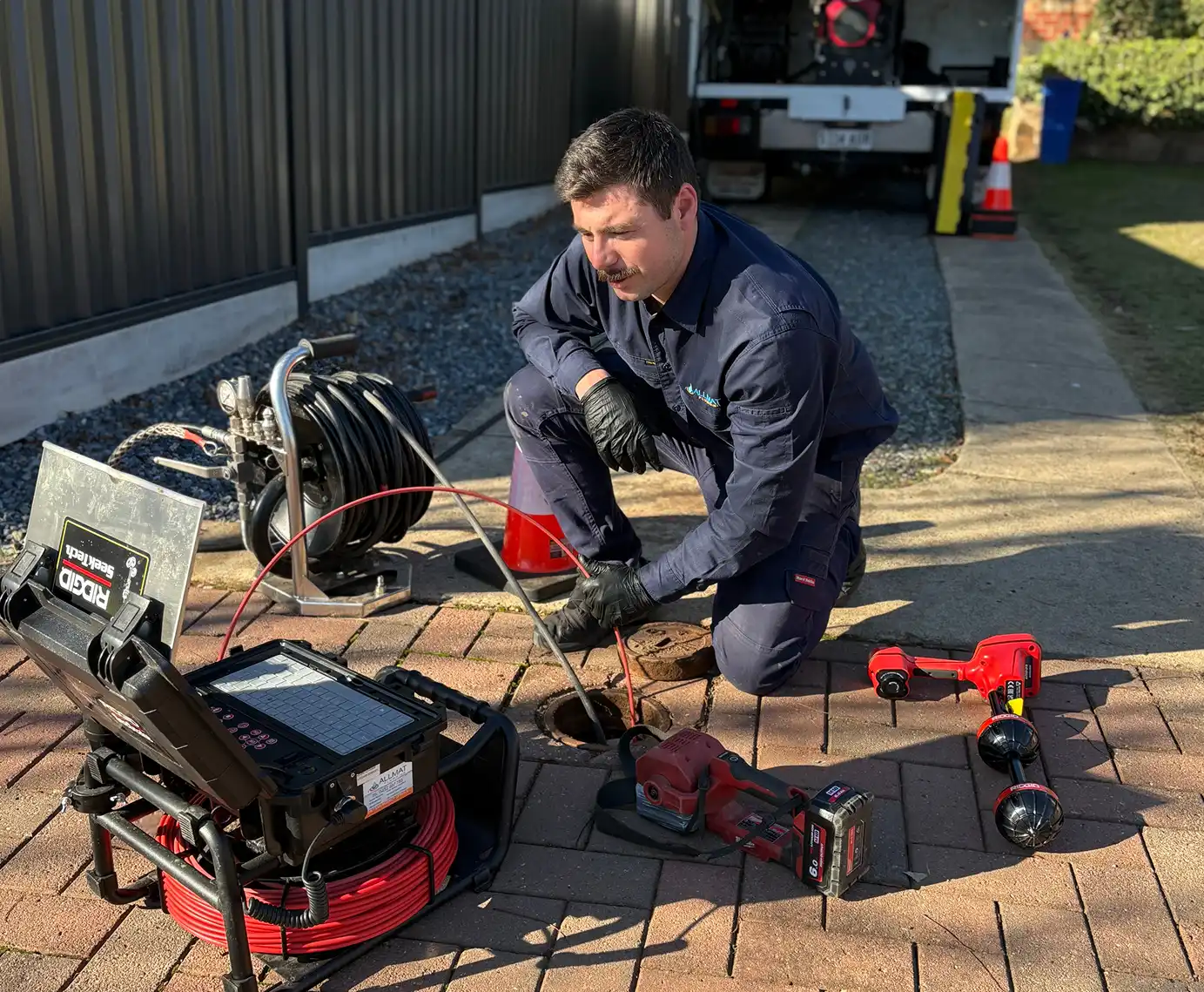
A CCTV drain inspection sends a waterproof camera through the drain on a push rod so you can see the actual fault: the root mass, the crack, the sag, the collapse or the object in the way. A transmitter in the camera head is tracked from the surface, so the defect gets marked on the ground with a distance and a depth before anyone quotes a repair. No reline and no excavation should be priced without one.
Related: Blocked Drains · Pipe Relining · Hydrojet Drain Cleaning
What a drain camera actually shows you
An inspection answers 3 questions that nothing else can answer: what the defect is, where it sits, and how bad it has become. A blocked drain that clears with a machine has told you only that something was in the way. The camera tells you whether that something was root hair at a single joint 11m from the house, a fractured section under the driveway, or a sag holding standing water that will silt up again by winter.
The distinction that matters is between the blockage and the reason for the blockage. A drain that blocks repeatedly is structurally faulty, and whatever came out of it is a symptom. Clearing the line without looking inside it is the plumbing equivalent of resetting a tripped breaker without asking what tripped it.
- Root intrusion, and specifically whether roots are entering at 1 joint or along an entire run.
- Fractures, longitudinal cracks and missing sections of pipe wall.
- Displaced or dropped joints, including how large the step is and which way it faces.
- Sags holding standing water, which is what reactive Adelaide clay does to a bedded pipe over decades.
- Scale, fat and soap narrowing the bore, common in narrow original wastes.
- Collapse, which rules relining out on the spot and sends the job to excavation.
- Foreign objects: rag, wipes, a dropped trowel, render and rubble left behind at a rough-in.
- Badly cut or unsealed junctions, including connections made during a renovation that were never done properly.
- Stormwater cross-connected into the sewer, which shows itself as a drain that surcharges only in heavy rain.
The locator does more for your bill than the camera does
The camera head carries a sonde, a small transmitter broadcasting a signal up through the soil. A locator wand tracks that signal from the surface and marks the ground directly above the camera head, with a depth reading. That is the step that decides what the repair costs.
An excavation quote is mostly a function of how much ground gets opened up. A defect described as "somewhere out the back" is a trench. A defect marked at 8.4m from the inspection opening, 1.1m deep and 600mm off the fence line, is a hole you can stand in. Across a paved courtyard or a concrete driveway, that difference is a great deal of demolition and reinstatement that never has to happen.
Depth readings hold to roughly 10% in ordinary soil and get less reliable near metal: reinforcing mesh, a steel fence, a buried service running parallel. The cross-check is worth watching for. Rod length fed into the drain should agree with the distance walked on the surface, and where those 2 numbers disagree there is either a bend or a problem.
What Adelaide drains look like on camera
Adelaide drainage was laid across roughly 130 years in at least 5 different materials, and the suburb and the build era tell you most of what to expect before the reel comes off the truck.
| Build era | Likely drain material | What tends to show up |
|---|---|---|
| Pre-1940 villa, bungalow or cottage | Vitrified clay in short lengths, mortared joints | Root hair through open joints, displaced collars, sound pipe barrel |
| Postwar brick and tile, 1950s to 1960s | Clay sewer, terracotta or asbestos cement stormwater | Cracked stormwater, sagging runs, silt loading, buried gullies |
| Mid 1970s onward | PVC, solvent welded | Sags from poor bedding, crushing under driveways, construction debris |
| Any era near the coast | Mixed, laid in sandy bedding | Sand ingress and heavy silt in stormwater, scoured bedding under the pipe |
| Infill townhouse on an older allotment | New PVC tied into original drainage | Undersized original run, poor fall at the tie-in, surcharge upstream |
Asbestos cement pipe is the one worth flagging. It went into plenty of Adelaide stormwater and some sewer work through the 1950s and 1960s, it is still in the ground under a lot of postwar housing, and it is stable while it stays undisturbed and wet. Knowing it is there changes how the line gets cleaned and how any excavation is handled. Identifying it with a camera is a great deal better than discovering it with a cutting head.
The other Adelaide signature is the sag. Reactive clay through the inner south and the foothills swells in a wet winter and shrinks hard through a dry February, and over decades it pulls a bedded pipe out of grade. On camera it reads as a pool of standing water in the invert. A sag does not block by itself, it collects, and the drain then blocks downstream of the real fault. That is exactly where guessing gets expensive.
When an inspection is worth it, and when it is not
Not every drain needs a camera, and we would rather tell you that up front than film a run you did not need. Here is where an inspection earns its keep, and here is where it does not.
- Get one before any reline or excavation is quoted. There is no honest way to price a repair to a pipe nobody has looked inside.
- Get one on a drain that blocks on a seasonal rhythm, because that pattern is structural rather than behavioural.
- Get one after a blockage that took real effort to clear, or that returned within weeks.
- Get one when the overflow relief gully has surcharged, because that means the whole system backed up rather than a single fixture.
- Get one before buying a character home in the inner suburbs, where a standard building inspection stops at the fixtures.
- Get one before tying a new bathroom, laundry or rear extension into original drainage.
- Get one when you need to establish whether the fault sits on your side of the SA Water connection point or theirs, because that decides who pays for it.
- Get one when 2 plumbers have given you 2 different diagnoses.
- Skip it for a single blocked basin, shower or sink while the rest of the house drains normally. That is a trap or a branch, and it is cleared in an hour.
- Skip it for a first blockage that cleared easily and has not come back. Watch it for a season instead.
- Skip it for a slow bathroom basin, which is hair and soap in the trap almost every time.
- Skip it while the drain is still full. The camera cannot see through sewage, so the line gets cleared first and inspected second.
- Skip it for a toilet that flushes poorly but drains fine once it goes. That is a cistern fault, not a drain fault.
What a proper inspection report has to contain
The footage on its own is close to useless 6 months later, because nobody remembers which end of the run they were watching. The report is what gives the footage a value.
- Continuous footage of the run, from the access point to where the camera stops, and a note on why it stopped.
- The pipe material and internal diameter, stated rather than assumed.
- Every defect listed with a distance from a named, permanent reference point.
- A depth at each defect worth digging up, taken with the locator.
- A severity assessment: what needs repair now, what gets monitored, what is cosmetic.
- Standing water and grade problems noted, since those change the repair method entirely.
- A plain-language recommendation with the reasoning attached, not just a price.
- A statement of which side of the SA Water connection point the fault sits on.
- Your own copy of all of it, to keep.
Keep the report with the house papers. A documented drain is worth money at 3 moments: when an insurer asks for evidence, when a building inspector asks about the sewer during a sale, and when the next plumber arrives in 8 years and does not have to start from zero.
Pre-purchase inspections on Adelaide character homes
A standard building inspection covers the structure and the visible fixtures. It does not cover the drain, and in the inner south and inner east the drain is routinely the oldest thing on the property. A bluestone villa at Unley, Malvern or Norwood can present beautifully and still be sitting on a clay sewer laid in the 1910s with the joints working themselves open under a row of mature street trees.
The asymmetry is the argument. An inspection is a small piece of work, and repairing a failed sewer under a paved courtyard or a driveway is not. Finding out about it after settlement makes it entirely yours. South Australian private treaty contracts carry only a short cooling-off period and auction sales carry none, so the inspection gets organised early rather than in the last week.
A bad result is not automatically a reason to walk. Dated footage and a written report get used to adjust an offer far more often than they get used to withdraw one.
Questions we get asked
Do I get to see the footage myself?
You should, and you should be given a copy to keep. Watching the run while it happens is worth doing: you get to ask what you are looking at, and you can see for yourself whether the defect being described actually looks like the defect on the screen. Marc is happy to walk you through the footage on the day and to leave you with a copy of it.
Can a drain camera find a water leak?
No, and this is a common mix-up. A drain camera looks inside non-pressurised waste and stormwater pipes, and it cannot go into a water supply line that is under pressure. A supply leak is found a different way: the meter test first, then isolating the property in sections at the taps that already exist and holding each section under pressure until the one losing water is known. Thermal imaging and a moisture meter are the tools that narrow it from there, and only where there is something for them to read. A thermal camera reads surface temperature rather than seeing through the floor, so it is at its best over a hot water line under a slab, where the warm plume shows through the concrete, and a moisture meter maps how far the water has tracked through plaster, timber and screed. On a cold line with no temperature contrast the section pressure test is what does the narrowing. If your water meter is turning with every tap off, that is leak detection. If the drain is backing up or gurgling, that is the camera.
Does the drain have to be cleared before the camera goes in?
Yes. The camera sees nothing through a line full of water and waste, so a blocked drain is jetted or machine-cleared first and filmed second. That order also produces the better inspection, because a jetted pipe wall shows its cracks and open joints clearly instead of hiding them under fat and silt.
How deep can the camera tell me the pipe is?
The sonde in the camera head is tracked from the surface with a locator, which reads both position and depth. Expect accuracy to roughly 10% of depth in normal ground, degrading close to reinforcing mesh, steel fencing or a parallel metallic service. Domestic sewers around Adelaide sit mostly between 600mm and 1.5m, deeper as they approach the connection point.
Will the inspection tell me whether SA Water pays or I do?
It establishes where the fault sits, which is what decides the question. The private sanitary drain inside your property boundary is the owner's responsibility, and the sewer main and the connection point are SA Water's. A located defect with a measured distance from a fixed reference is the evidence that separates the 2, and it is worth having before any phone call about who pays.
Can you inspect stormwater as well as the sewer?
Yes, and on Adelaide properties with a history of flooding through the yard it is the more useful of the 2. Stormwater lines silt up, get crushed under later driveways and paving, and get connected to downpipes that were never on the original plan. The camera also settles the cross-connection question, which matters because stormwater running into the sewer surcharges the whole system in a downpour.
Should I get a drain inspection before buying a house?
On anything built before about 1960 in the inner suburbs, yes. Standard building inspections stop at the fixtures, and the sewer is usually the oldest asset on the block. An inspection before settlement is a small piece of work set against repairing a failed sewer afterwards, and the report is negotiating material rather than only a reason to walk away.
Suburbs we cover for cctv drain inspection
You might also find this useful
- Tree Roots in Pipes: The Adelaide Guide to Stopping the DamageA drain that blocks every year around the same time is not being overused. It is taking tree roots through an open joint. Here is how roots actually get in, which Adelaide trees do it, what each fix genuinely buys you, and the treatments that waste money.
- The Overflow Relief Gully: What It Is, and Why Yours Is BlockedAn overflowing ORG is not a fault, it is the safety valve doing its job. What to do in the first 5 minutes, how to check yours is installed legally, and who pays for the blockage.
- Why Is My Kitchen Sink Gurgling When I Flush the Toilet?The gurgle is air being pulled through a trap seal. Which fixture makes the noise, and which fixture triggers it, tells you whether you are dealing with a free fix under the sink or a root-blocked sewer near the boundary.
- Pipe Relining vs Pipe Replacement: How to Choose the Right RepairPatch relining and excavation are 2 tools for 2 different faults. The pipe conditions that decide it, what the camera has to show before a liner is an option, and when digging is genuinely the better repair.
- Blocked DrainsBlocked sewer, toilet, sink and stormwater drains cleared across Adelaide with a jetter and an electric machine, then filmed with a CCTV camera so you find out what caused it.
- Pipe ReliningTrenchless patch repair for a cracked or root-invaded drain. A resin liner is cured inside the damaged section, so the fault is fixed permanently without digging up the yard.