
Hydrojet Drain Cleaning Adelaide: High-Pressure Water That Scours the Pipe Clean
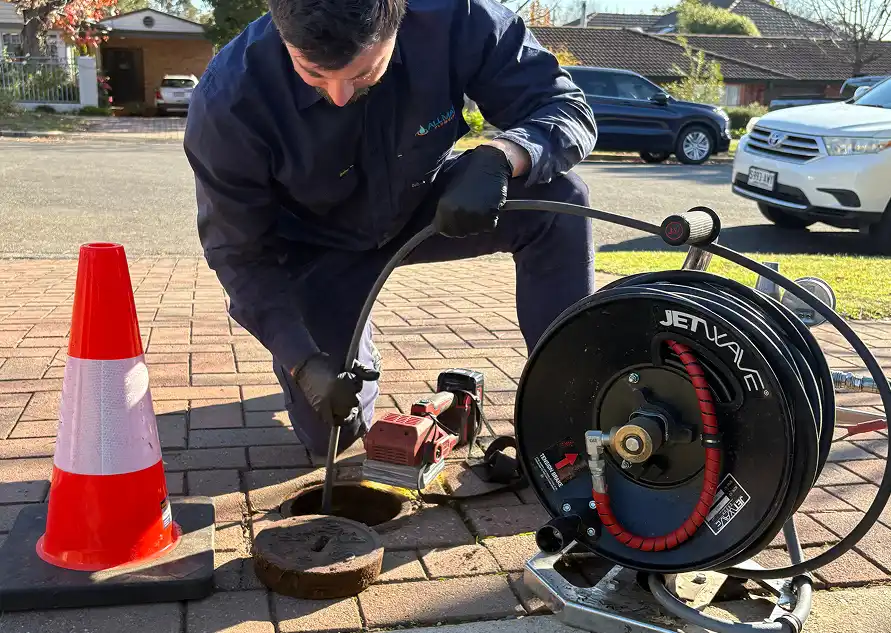
Hydrojet drain cleaning clears a drain with water at high pressure through a nozzle that drags itself up the pipe on its own rear-facing jets. It does not just bore through the blockage the way a cable machine does: it strips the pipe wall back to bare surface, so fat, silt, scale and root hair leave the line rather than staying in it. It is the right tool for roots, grease and silt, and the wrong tool for a collapsed pipe.
Related: Blocked Drains · CCTV Drain Inspection · Tree Root Removal
How a jetter actually clears a drain
A jetter is a pump, a long high-pressure hose and a nozzle. Most of the jets in that nozzle face backwards. They do 2 jobs at once: the reaction thrust pulls the hose up the drain against the flow, and the angled spray scours the pipe wall as it travels. A smaller forward jet opens the path through the blockage itself. The result is that the machine works its way to the far end of the run and then cleans on the way back, which is the opposite of how most people picture it.
Nozzle choice is the skill in this job, not the pressure dial. The same machine behaves completely differently depending on what is screwed onto the end of the hose.
- Flusher or standard nozzle: rear jets only, for silt, sand and general sludge in stormwater and sewer.
- Penetrator: a narrow forward jet to punch through a solid blockage before the wall gets cleaned.
- Root cutter or chain nozzle: a rotating head that shears root mass back to the pipe wall at a joint.
- Rotating descaler: for scale in old cast iron and heavy fat in narrow original wastes.
- Small-line nozzle: for 40mm and 50mm branch wastes, where a full-size head will not fit and would not be safe if it did.
Pressure and flow are 2 different numbers and both matter. Pressure, measured in psi, is what cuts. Flow, measured in litres per minute, is what carries the debris back out of the drain. A high-pressure unit with low flow will cut a root mass into pieces and leave those pieces in the line, ready to jam at the next bend. A machine with real volume behind it flushes the material back to the access point where it can be removed.
Jetter versus an electric eel
The cable machine, the electric eel, has been the standard drain-clearing tool for decades and it still earns its place. It is just answering a different question.
| Consideration | Cable machine (eel) | Hydrojetter |
|---|---|---|
| What it does | Cuts or bores a path through the obstruction | Strips the full pipe wall and flushes the material out |
| Result on roots | Cuts a channel through the root mass | Shears roots back to the wall and removes the debris |
| Result on fat and scale | Punches through, leaves the coating behind | Removes the coating, restores full bore |
| Silt and sand | Largely ineffective | The right tool |
| Access needed | Works through small openings and inside the house | Needs a proper access point and room for the truck |
| Water needed | None | Needs a supply, and the truck carries a tank |
| Typical repeat interval | Shorter, because the build-up stays | Longer, because the pipe is left clean |
The honest summary: an eel is quicker and cheaper on a single blocked fixture, a toilet pan, a short internal branch or a fragile line that should not be pressurised until somebody has looked at it. A jetter is the correct answer on a main sewer or stormwater run, on anything involving roots, and on any drain where the goal is to leave it clean rather than merely flowing again by lunchtime.
What it clears around Adelaide, and what it will not touch
Adelaide produces a fairly predictable set of blockages, and the suburb tends to tell you which one you are about to meet.
- Root hair through open clay joints, the signature fault of the pre-war inner south and inner east.
- Fat, soap and food waste in narrow original kitchen wastes, particularly where a dishwasher was added to 60-year-old pipework.
- Silt and sand in stormwater, heaviest in the coastal suburbs and anywhere with a broken or missing pit lid.
- Scale inside old cast iron stacks and wastes.
- Sludge and grit sitting in the base of an overflow relief gully line.
- Wet wipes and rag, which knit together and then catch on any imperfection in the pipe.
- Builder rubbish left in a drain during a renovation, where it is soft enough to break down.
What jetting will not do is repair anything. That sounds obvious and it is still where most of the disappointment in this trade comes from, so here it is plainly.
- It will not fix a collapsed pipe. Water goes around the debris, the drain runs for a day, and the collapse is still a collapse.
- It will not fix a sag. A run holding standing water will silt up again on the same schedule it always has.
- It will not permanently stop tree roots. It cuts them back at the joint they came through, and that joint is still open.
- It will not correct fall, and a drain laid at the wrong grade in 1968 is still laid at the wrong grade.
- It will not shift concrete, a dropped tool or a length of steel. That is a cutter job or an excavation.
Pressure, old pipe, and the judgement that gets skipped
A lot of what sits under Adelaide is old, and some of it is fragile. Vitrified clay laid before 1940 is strong in the barrel and weak at the joints. Terracotta stormwater cracks. Asbestos cement stormwater from the 1950s and 1960s is stable while undisturbed and should never be attacked blind with a rotating cutting head. Pushing maximum pressure into a pipe that is already broken can wash bedding soil in through the crack, enlarge a void under the pipe, or open a displaced joint further than it was.
The correct approach on an unknown drain is conservative and then escalating: a smaller nozzle and moderate pressure first, watch what comes back, then a camera before anything aggressive goes in. On a known PVC line with a fat blockage there is no reason to hold back. On a 110-year-old clay sewer under a heritage frontage, the machine capable of clearing it is also capable of making the repair bill considerably larger, and the difference is entirely in who is holding the hose.
What happens on the day
- Find and open the access. An inspection opening is first choice, the overflow relief gully second, a fixture or roof vent as a last resort.
- Establish what the drain is: material, approximate age, what it serves and where it runs.
- Protect the surrounds. Jetting a sewer sends water and waste back to the opening, so the area is contained before the pump starts.
- Select the nozzle for the suspected blockage, starting conservative on any pipe of unknown condition.
- Work the line in passes rather than a single push, so the debris is flushed back progressively instead of being packed forward.
- Remove the material at the access point. Debris left at the opening is a blockage waiting to happen.
- Run the camera. A clean pipe is the only condition in which the wall can be assessed properly, so this is the moment to look.
- Report what was found, with a plain recommendation on whether the drain needs anything beyond the clean.
Most domestic clears run 1 to 2 hours. A long run with heavy root mass takes longer, and a drain that will not clear inside a reasonable time is telling you something that more hours will not change. That is the point to stop jetting and start looking.
Marc discusses the price with you before the pump starts, and if the drain turns out to need more than a clean you get told what the options are before anything else happens.
Questions we get asked
Will high-pressure water damage my pipes?
Not a sound pipe. A jetter is used on drains every day without harming PVC, sound clay, copper or cast iron. Damage happens when full pressure is applied to a pipe that is already broken, misaligned or made of something fragile, which is why the pressure and the nozzle get matched to the drain rather than turned up by default. On an unknown line the sensible sequence is a smaller nozzle, moderate pressure and a camera before anything aggressive.
Is hydrojetting better than an electric eel?
For a main sewer or stormwater run, yes. An eel cuts a path through the blockage and leaves the fat, scale and root debris coating the pipe, so the drain blocks again sooner. A jetter removes the material and leaves a clean wall. The eel still wins on a single internal fixture, a toilet pan and a short branch waste, where a jetter is more machine than the job needs.
Does jetting remove tree roots permanently?
No. Jetting shears the roots back to the pipe wall and flushes them out, which restores full flow, and the root system outside the pipe is untouched. The joint they came in through is still open, so they come back, usually on a seasonal cycle. Closing that route off means a patch reline over the affected section, so there is no longer a joint to grow into.
How often should a drain be jetted?
A sound domestic drain with no root problem does not need scheduled jetting at all. A property with known root intrusion that is not being relined yet typically gets done every 12 to 24 months, timed before the wet season rather than after the first backup. A commercial kitchen is a different animal and usually runs on a 3 to 6 month cycle depending on volume and how well the grease trap is managed.
Can you jet a stormwater drain as well as a sewer?
Yes, and around Adelaide it is underrated work. Stormwater lines fill with silt, leaf litter and sand, and the failure shows up as water pooling in the yard or backing out of a pit during a downpour rather than as a smell inside the house. Desilting before winter is far cheaper than dealing with water finding its way under a slab.
Do I need a camera inspection as well as the jetting?
On a first-time blockage that clears easily, no. On a drain that has blocked before, took real effort to clear, or backed up through the overflow relief gully, yes, and immediately after the clean while the pipe wall is clean enough to assess. That is the only moment the camera can see cracks and open joints instead of a coating of fat and silt.
Can I hire a jetter and do it myself?
Drain-cleaning attachments for domestic pressure washers exist and they are genuinely useful on a downpipe or a short stormwater run. They are not useful on a sewer: the pressure and flow are nowhere near enough, the hose is short, and the 2 real risks are worth taking seriously. A hose can jam in the line and become the new blockage, and pressure into a cracked pipe can turn a repair into an excavation.
Suburbs we cover for hydrojet drain cleaning
You might also find this useful
- Are Flushable Wipes Really Flushable? What Adelaide Drains ShowToilet paper falls apart in minutes. Wipes labelled flushable do not. Here is what the testing found, why Adelaide clay sewers catch them so reliably, and how to tell a wipe blockage from a root blockage.
- Do Supermarket Drain Cleaners Damage Your Pipes?Most pages on this subject say never use them, which readers do not believe because the bottle sometimes works. Here is the accurate version: what is in it, what it damages, the narrow case where it is a fair choice, and the symptoms that mean it will never help.
- Why Do My Drains Smell Like Rotten Eggs, and How Do You Fix It?Rotten egg means hydrogen sulphide, and there are only 3 realistic sources in a house. Work out which one you have first, because the fix for a dry trap, a biofilm build-up and a hot water anode have nothing in common.
- Tree Roots in Pipes: The Adelaide Guide to Stopping the DamageA drain that blocks every year around the same time is not being overused. It is taking tree roots through an open joint. Here is how roots actually get in, which Adelaide trees do it, what each fix genuinely buys you, and the treatments that waste money.
- Blocked DrainsBlocked sewer, toilet, sink and stormwater drains cleared across Adelaide with a jetter and an electric machine, then filmed with a CCTV camera so you find out what caused it.
- CCTV Drain InspectionA RIDGID SeeSnake camera and locator find the exact fault in a drain, how far it sits from the house and how deep it is, so the repair is priced on evidence instead of guesswork.