
Stormwater Drain Maintenance in Adelaide: The Autumn Checklist
Adelaide stormwater systems fail in autumn, and the work that prevents it is done before the first real rain. Roughly 530mm of rain falls on Adelaide in a year and most of it arrives between May and September, so a system that quietly silted up over a dry summer meets its first serious test in a single May downpour. Clearing gutters, checking that every downpipe still discharges somewhere, and running a hose through each line takes an afternoon and catches most faults. The 3 that warrant a plumber are pooling that lasts more than a few hours, water entering a garage or subfloor, and a downpipe going nowhere.
Need this sorted rather than explained? Stormwater Drain Cleaning in Adelaide. Also worth reading: Tree Roots in Pipes: The Adelaide Guide to Stopping the Damage · Are Flushable Wipes Really Flushable? What Adelaide Drains Show
What actually fails in an Adelaide stormwater system
Stormwater rarely fails the way people expect. It is not usually a single object jammed in a pipe. It is accumulation: leaf litter, roof grit, sand and clay silt settling in the flattest part of the run over several dry months until the effective bore is half what it was. Then a storm arrives and asks the line to carry its full design flow in 20 minutes. Adelaide adds some very local failure modes on top of that.
- Kerb outlets rendered or paved over. Many inner-south properties discharge through a hole in the kerb rather than an underground council main, and driveway crossovers and kerb repairs regularly seal them.
- Silted soakage pits. Older properties around Goodwood, Millswood, Black Forest and Colonel Light Gardens frequently have no legal stormwater connection at all. The downpipes feed a rubble pit that worked beautifully in 1935 and is now clay-choked solid.
- Downpipes disconnected at the shoe. The most common fault of all, and the simplest to put right. Every storm then dumps a roof into the soil against a footing.
- Terracotta stormwater in post-war suburbs. Short lengths, open joints, and the same root intrusion story as the sewer, just shallower.
- Agricultural drain wrongly connected into stormwater. Slotted ag pipe admits groundwater by design, so without a silt arrestor it feeds fine soil into the line continuously.
- Surface pits and driveway grates sitting over a silted sump. The grate looks clear from above while the chamber beneath it has filled with sand, mulch and roof grit, so the pit holds water after rain and the line downstream never sees full flow.
The autumn checklist, before the first real rain
Bureau of Meteorology records put Adelaide at roughly 530mm of rain a year, with June and July the wettest months and the great majority falling from May to September. Summer contributes little, and what it does contribute arrives as short violent thunderstorms. That gives a homeowner a clear window: do this in March or April, on a dry Saturday, with a garden hose.
- Clear the gutters and roof valleys by hand, including under any leaf guard. Guards divert leaf into fewer places, they do not eliminate it.
- Check the fall of the gutter towards each downpipe. Gutter sagged between brackets holds water and silt, and silt is what reaches the pipe.
- Follow every downpipe to the ground and confirm it connects to something. Look for a rusted shoe, a gap at the joint, or a pipe ending in a garden bed.
- Run a hose at full flow into each downpipe for 2 minutes, then watch the discharge point. Water should arrive within seconds, at roughly the volume you put in.
- Lift every surface pit and grate, scoop out the silt, and check the outlet is clear and lower than the inlet.
- Find the kerb outlet at the front and clear it. Roadside silt, mulch and grass block them constantly, and a blocked outlet backs the whole system up from the far end.
- Check the sewer overflow relief gully while you are outside. It should sit above the surrounding ground with the grate clear, so stormwater cannot enter the sewer.
- During the first real storm, photograph where water sits. Pictures taken during the event beat any description afterwards.
Why pooling water is a footing problem, not a lawn problem
Here is the part that matters more than a wet lawn, and it is why stormwater deserves attention in Adelaide specifically. Much of the metropolitan area sits on highly reactive clay, which swells when it takes up water and shrinks when it dries. The vertical movement across a season can be substantial. Footings here are designed around it, which is what the site classifications in the Australian slabs and footings standard describe.
The damage is not caused by wet soil. It is caused by unequal soil moisture. When a downpipe discharges against a corner of the house through winter while the opposite side sits under a wide eave and stays dry, the clay lifts under part of the footing and settles under another. The footing has to bridge the difference, and it announces the failure in the brickwork: stair-stepped mortar cracks, cracks running diagonally from door and window heads, doors that stop closing in spring and start again in February, and gaps between cornice and wall.
CSIRO published the standard homeowner guidance decades ago and it has not changed: keep soil moisture around the perimeter as even as you can, and get roof water away from the footing rather than into it. That principle makes stormwater maintenance some of the highest-value work available on an Adelaide house.
Where your responsibility stops and the council's begins
Stormwater has a different ownership map from water and sewer, and it catches people out. SA Water runs the drinking water and sewer networks. Stormwater in the street belongs to the local council: the kerb and gutter, the side entry pits and the underground network. The boundary between you and the council is the legal point of discharge, usually a kerb outlet at the front or a connection into a council drain.
- Everything on your side of the point of discharge is yours: gutters, downpipes, underground lines, pits, sumps, pumps, and the connection itself.
- Council approval is normally required to create a new kerb outlet or connect into the council network, and the cost sits with the property owner.
- On an easement crossing your land, the drain may serve properties upstream. Check the certificate of title before assuming a pipe in your yard is yours alone.
- On strata or community title, shared stormwater lines are usually common property, which changes who authorises the repair and who pays.
When you genuinely do not need work done
A flooded backyard looks alarming, and it is easy to assume the answer has to be a large one. Most Adelaide houses do not need a new system, a detention tank, or a pump.
- Water sitting on a lawn during an intense downpour and gone within an hour or 2 is the system working. Grassed areas are meant to detain water briefly.
- A single episode in an unusually severe storm is not evidence of an undersized system. Every system has a design capacity, and rain beyond it overflows somewhere.
- A puddle in a low corner 15 metres from the house, on clay, is a grading question. It does not need a drain, and running one to it may move the water somewhere worse.
- Gutters overflowing at a single point in heavy rain usually means a sagged gutter or an undersized downpipe, not a failed underground line.
- A sump pump is for a site that cannot drain by gravity, such as a below-grade garage. On a normal sloping allotment it is an expensive answer to a question nobody asked.
The faults that are worth fixing
The other half of the honesty is naming what should not be left. These faults get worse, and every one of them costs more in the second year than the first.
- Water entering a garage, a subfloor or under a slab. Act on that immediately: damp under a house means timber, mould and reactive clay working against you at once.
- A downpipe discharging at the base of a wall. Quick to fix, and directly responsible for the uneven soil moisture that cracks walls.
- Pooling that persists for a day or more against the house after ordinary rain. Ordinary rain is the test, not a storm.
- A blocked or collapsed line confirmed on camera. Terracotta stormwater fails the same way as terracotta sewer, and roots take its joints just as readily.
- A soakage pit that no longer soaks. Once the surrounding clay has sealed, the pit is a bucket, and the fix is a proper connection rather than a bigger hole.
- A stormwater line connected to the sewer, or an overflow relief gully sitting below the surrounding ground so surface water can enter it.
- Roof area added without upgrading the drainage. Verandahs, carports, extensions and sheds all add flow to a line sized for the original house.
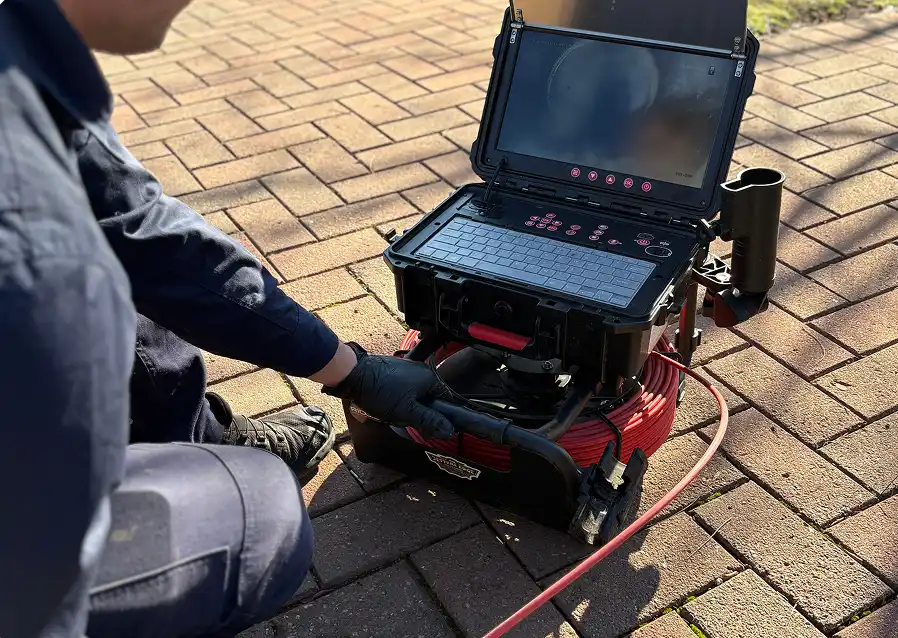
The diagnostic method is the same as for sewer. Jet the line to clear silt and roots, run the CCTV camera to see the pipe itself, and locate any defect from the surface so it can be repaired precisely rather than chased with a shovel. Stormwater lines are generally shallower and smaller than sewer, which usually makes both the inspection and the repair simpler.
Questions we get asked
How often should stormwater drains be cleaned in Adelaide?
Gutters and downpipes, once a year as a minimum, in autumn before the wet months. Under heavy tree cover, particularly deciduous street trees through the inner south, twice a year is more realistic: once in autumn and once after leaf drop finishes. Underground lines do not need routine jetting on a healthy system. Jet them when flow has visibly slowed, when a pit holds water after rain, or when a camera has shown silt or root build-up.
Can I connect my stormwater to the sewer?
No. Sewer and stormwater are separate systems in South Australia and connecting one to the other is unlawful. During heavy rain a stormwater connection delivers far more water than the sewer is designed to carry, which surcharges the network and pushes sewage into houses downstream. The same applies indirectly: an overflow relief gully that has ended up below the surrounding ground level lets surface water into the sewer, and correcting its height is a genuine repair rather than a nicety.
Who is responsible for the stormwater drain in my street?
The local council. Councils own and maintain the public stormwater network, including the kerb, gutter, side entry pits and underground drainage. You are responsible for everything on your side of the legal point of discharge, which is usually a kerb outlet at the front of the property or a connection into a council drain. If water is backing up from the street rather than from your yard, the council is the right first call.
Why does water pool in my backyard after every heavy rain?
Most often for 1 of 3 reasons: the surface has no fall to a drainage point, the pit or line serving that area has silted up, or the discharge point at the far end is blocked so the whole system backs up. Test the last of those first, because it is free. Run a hose into the highest downpipe and watch the kerb outlet. If nothing arrives, the fault is between the 2, and no amount of regrading the lawn will help.
Do I need a stormwater pump or a detention tank?
Probably not. A pump is the right answer for a site that cannot drain by gravity, such as a below-grade garage, a basement or a block sitting lower than the street. A detention tank is normally a planning requirement on a new build or a significant extension rather than something retrofitted to solve a puddle. On an ordinary sloping Adelaide allotment, gutters, downpipes and a clear line handle it, so those are the things to check before a pump is ever considered.
Can a blocked stormwater drain really crack my walls?
On Adelaide clay, yes, and it is one of the more common causes of cracking that gets blamed on the footing. Roof water discharging against a wall keeps that soil swollen while the other side of the house dries out, and the resulting differential movement is what opens stair-stepped mortar cracks and cracks above door and window heads. Fixing the drainage and allowing a full season before considering structural work is the sequence CSIRO guidance has recommended for decades.
References
You might also find this useful
- Stormwater Drain CleaningHigh pressure jetting, pit clearing and CCTV inspection for blocked and broken stormwater drains. Roof water moved away from the house properly, which on Adelaide clay matters more than most people are told.
- Tree Roots in Pipes: The Adelaide Guide to Stopping the DamageA drain that blocks every year around the same time is not being overused. It is taking tree roots through an open joint. Here is how roots actually get in, which Adelaide trees do it, what each fix genuinely buys you, and the treatments that waste money.
- Are Flushable Wipes Really Flushable? What Adelaide Drains ShowToilet paper falls apart in minutes. Wipes labelled flushable do not. Here is what the testing found, why Adelaide clay sewers catch them so reliably, and how to tell a wipe blockage from a root blockage.
- Do Supermarket Drain Cleaners Damage Your Pipes?Most pages on this subject say never use them, which readers do not believe because the bottle sometimes works. Here is the accurate version: what is in it, what it damages, the narrow case where it is a fair choice, and the symptoms that mean it will never help.